Ivor Stodolsky on STIOB

About a year ago, friend and colleague Nancy Ries recommended this article to me, correctly guessing I would be delighted at the resonance between the notion of stiob, my love of what the Situationists would call the parodique-serieux (I.S., number 3, December 1959) and my surname (plus an “i”). I came across the passage I had excerpted from the article during today’s end-of-the-year file clean-up, and thought I’d post it here for safe-keeping.

The Case of Stiob

The notion of stiob, in usage in nonconformist circles for decades, has recently received Western academic attention due to the work of Alexei Yurchak, who has integrated its explication into a broader theoretical framework (Yurchak 2005). He describes a ‘hyper-normalisation of form’ of official Soviet practices, juxtaposing this with their increasing lack of denotative semantic content in the late-Soviet period. Yurchak proposes the concept of a ‘performative shift’ to describe how certain formulaic acts (public eulogies for Communism, for instance—whether performed sincerely or not) often became ideologically vacuous means to totally different ends (Yurchak 2005, chapter 6). In lay terms, his diagnosis is of a mismatch of official form and non-official content.

In the late-Soviet culture of the late 1970s and early 1980s, stiob practices exaggerated this mismatch, propelling it into the realm of the absurd. Unlike the sharply ironic and politically-engaged attitude of the Thaw generation (shestidesyatniki), stiob was performed with mischievous humour and a façade of deadpan nonchalance. It was considered successful precisely when it duped the audience into believing something impossible or ridiculous. Ideally, the issue of the author’s sincerity was indefinitely unsettled and ambiguous. As Yurchak says, stiob ‘refuses the very dichotomy’ between seriousness and irony (2005:250).

Ivor Stodolsky, “A Multi-Lectic Anatomy of Stiob and Poshlost’: Case Studies in the Oeuvre of Timur Novikov” (2011). My emphasis.

Elizabeth Price wins the Turner

Still from “The Woolworths Choir of 1979,” Elizabeth Price, 2012. Image accessed at http://ichef.bbci.co.uk/images/ic/944×531/p012dcm7.jpg

Great to see that a video artist has been awarded the Turner Prize: Elizabeth Price. This small snippet of her piece, The Woolworths Choir of 1979 (2012) intrigues me. I’d love to see it in its entirety as an installation.

It’s difficult to know anything about the composition from what little can be seen online, but it speaks well of the piece that I’m immediately inspired to start piecing together and thinking over a couple recurring thematic motifs: the legibility/illegibility of emotive gesture and the commodification of femininity (in terms of news reportage of the tragedy, but also the erotics of girl groups). I imagine the snaps and clicks that seem to regulate the images as the sounds of these concepts locking and interlocking.

I’m also happy to see an artist who has been given this kind of platform valorize public art funding and stress the importance of keeping complex visual experience open to as wide an audience as possible.

Le décor et son usage

Below: another fascinating anecdote from Günther Anders‘ life, excerpted from Paul van Dijk.

After fleeing Nazi Germany in 1933, Anders lived in France for a couple of years and then emigrated to the USA in 1936. He stayed in the USA until 1950, sporadically publishing fiction and essays, working odd jobs, adjuncting in the academic system, and putting together his non-fiction magnum opus, Die Antiquiertheit des Menschen (The Antiquatedness of Humankind).

For part of his American exile, Anders lived in California, trying (unsuccessfully) to become a Hollywood scriptwriter and making ends meet. Of this period, van Dijk writes:

His job as a cleaner of movie props in the Hollywood Custom Palace thus led him to reflections on the philosophy of history and on the theory of knowledge that are recognizable in his later philosophy on the media. In March 1941, he wrote in his diary:

“Even though I am classified as an enemy alien and as an unskilled worker, I have nonetheless found a job. Although the job is rather odd. For I have become history’s corpse cleaner. Since [sic] one week I belong to the cleaning crew of the Hollywood Custom Palace. The word “custom” has nothing to do here with customs; it refers instead to costumes. The twelve-story colossus, the “palace” where I spend my working days, is a museum of the entire costume past of humanity, an arsenal which rents out everything to the great film companies that our predecessors and our contemporaries, including their slaves, pets and riding animals, ever wore on their bodies and still wear today. From Eve’s fig leaf gadget (in both a see-through and a non-see-through version) to the riding boots of the German attack forces which–oh, such breathtaking optimism–hang next to the footgear of other eras, as if they already are brother and sister to the Greek sandals and the imperial riding boots, past history in other words. If I am instructed to polish these boots, then as an unskilled member of the cleaning crew I can hardly refuse. We flee from the original and then run the risk, a few years later an on the opposite side of the world, to have to clean the duplicates for pay!

Anyhow, we can learn a thing or two from this, even the fundamental truth of the rag philosophy. We human beings do not cover our nakedness to prevent ourselves from freezing to death, but because without cover we would be unable to present ourselves as persons of status, to establish hierarchies, to entice our fellow men or women, or to intimidate others. Surely, there are real needs at the basis of the fantastic discovery that is called clothing, but ultimately those needs are hardly physiological. The pieces that lie around here hardly include any that are strictly meant to keep warm. They are all instruments of dignity or to terrify or flatter, social instruments all. This truth is being whispered into my ear each day as I rub, brush or vacuum these pieces.” (1985, p. 1f)

Van Dijk 10-11

The movie set of Alexandria, constructed in suburban London for Joseph Mankiewicz’s CLEOPATRA (1963) and abandoned six months into shooting. Accessed at http://images.travelpod.com/tw_slides/ta00/9b9/63e/cleopatra-set-on-backlot-slough.jpg

Anders was not alone in finding inspiration in the cinematic industry for his theories on the substitution of illusion for reality. The anecdote above reminds me of the Situationists’ sardonic treatment of a news item about the movie set for Cleopatra (Mankiewicz, 1963) in their 1961 issue of Internationale Situationniste.

The movie nearly bankrupted its Hollywood studio, in part because of the ornate and gigantesque “ancient Alexandria” set which needed to be built twice over the course of the production. The Situationists found this fiasco emblematic of spectacular culture: they believed capital and its images erode history and the present at the same time.

La Carte d’Après Nature

I’ve been intensely curious about philosopher, poet, novelist and media theorist Günther Anders since seeing Nicolas Rey’s anders, Molussien at the NYFF in October. I ordered the second edition of Anders’ Die Molussische Katakombe (Munich: C.H. Beck, 2012) and a handful of other texts on and by him. I’ll share here and in a second post two amazing anecdotes from Anders’ life that I found poetically ironic and Molussia-worthy. Both are in slightly screwy Dutch-inflected English, from Paul van Dijk’s Anthropology in the Age of Technology: The Philosophical Contribution of Günther Anders (Amsterdam: Rodopi, 2000) :

The first version of the book [Die Molussische Katakombe] was ready before Hitler came to power. Bertolt Brecht, who had helped him get a job as a magazine editor with the Berliner Börsen-Courier, for which he took on the characteristic pseudonym Günther Anders (anders means “different,” referring to his Jewish self-consciousness), handed the manuscript to Brecht’s publisher Kiepenheuer. But it was too late for publication; the Nazi secret police were a step ahead. The publisher, however, had given it an innocent look by presenting an old map of Indonesia on the cover, showing the mythical island of Molussia. When the Gestapo invaded the publishing plant, the trick turned out to work. The censors took only a cursory look at the manuscript, apparently thinking that it was some South Seas fairy tale, and sent it back. Nonetheless, the book could not be published in Germany, also not in France, and thus lost its function as a warning against the Nazi political system. Not until 1992, sixty years later, did it appear in print, with Beck, Anders’ publisher in Munich[…]

On 28 February 1933, one day after the Reichstag fire, an advance publication of Die Molussische Katakombe appered in the Berliner Tageblatt. From that day onward, Anders belonged to those who were no longer safe in Germany. Via Brecht, he had recovered the manuscript of his novel. Since he knew, however, that his name appeared in Brecht’s address book, which had fallen into the hands of the Gestapo, he fled to Paris. He did not dare to take the manuscript with him. It was hidden by friends, wrapped in parchment paper, in a chimney flue between the smoked sausages and hams. For months, it hung in there, until Hannah Arendt, Anders’ wife at the time, who later was to become famous as a philosopher, emigrated to Paris also. For the time being, it received a different purpose, as Anders tells it. “As we did not have enough to eat at times, I used the manuscript as an aromatic sauce. I smelled it when eating my baguette.” (1987b, p. 31).

Van Dijk 8-9

ONE, Dan Graham, 1967

ONE, Dan Graham, 1967

A photograph from the exhibition catalogue, Dan Graham: Beyond (organized by Bennett Simpson and Chrissie Iles; essays by Rhea Anastas … [et al.] ; interviews with Dan Graham by Kim Gordon, Rodney Graham, and Nicolás Guagnini ; manga by Fumihiro Nonomura and Ken Tanimoto; Cambridge: MIT Press, 2009).

Unfortunately, the photograph isn’t addressed directly in the text. I’m wondering whether the photograph is documentation or the artwork, itself, and whether it was part of a photographic series…A “to be continued.”

L’Invention Collective

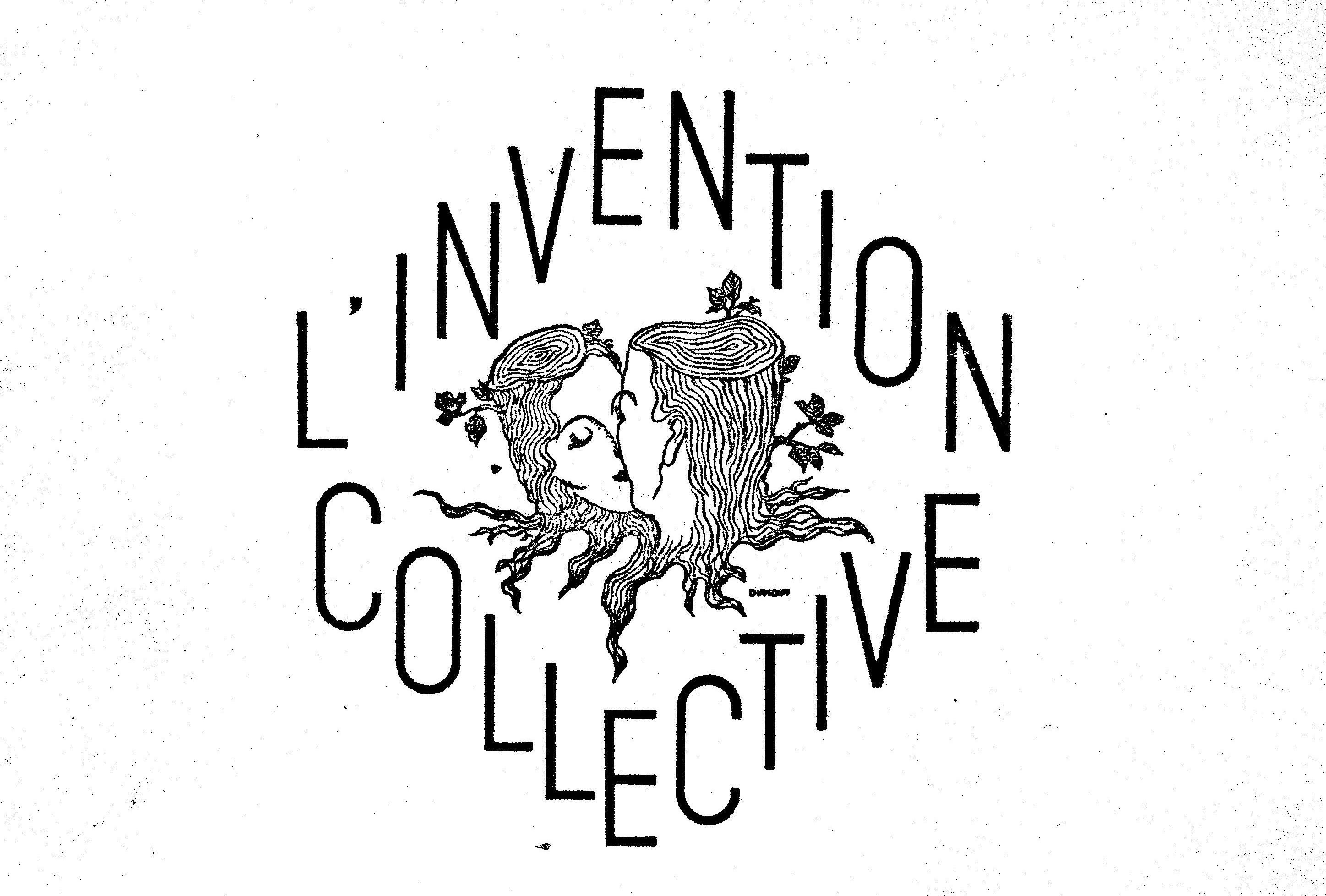
This image was the header of the Belgian surrealist journal, L’Invention Collective. The journal was short-lived; only two issues were published. Nevertheless, appearing as it did in the winter of 1940, it constituted perhaps the sole voice of surrealist creation during the Second World War. Paul Nougé was the journal’s editor.


Nixon/Agnew

Emory Douglas, Nixon/Agnew, from Black Panther newspaper. Offset lithograph. Copyright 2009 Emory Douglas/Artists Rights Society (ARS), New York.

As the Republican National Convention kicks off in Tampa, FL…

Emory Douglas’s psychedelic-and-engagé graphic art.

This was another discovery from West of Center: Art and the Counterculture Experiment in America, 1965-1977.

Here is Colette Gaiter’s description of the above print, from her essay, “The Revolution Will Be Visualized: Black Panther Artist Emory Douglas” in the compilation:

Collage was one of Douglas’s most favored techniques. In the Richard Nixon/Spiro Agnew image, he juxtaposed a photograph of the Republican nominees celebrating their ticket (from the cover of Time magazine on August 16, 1968) with images of anguished black people[…]Douglas’s collage alludes to controversial perceptions that the Nixon administration neglected problems of the urban, mostly black, poor. (246)

The 7,000 Year Old Woman

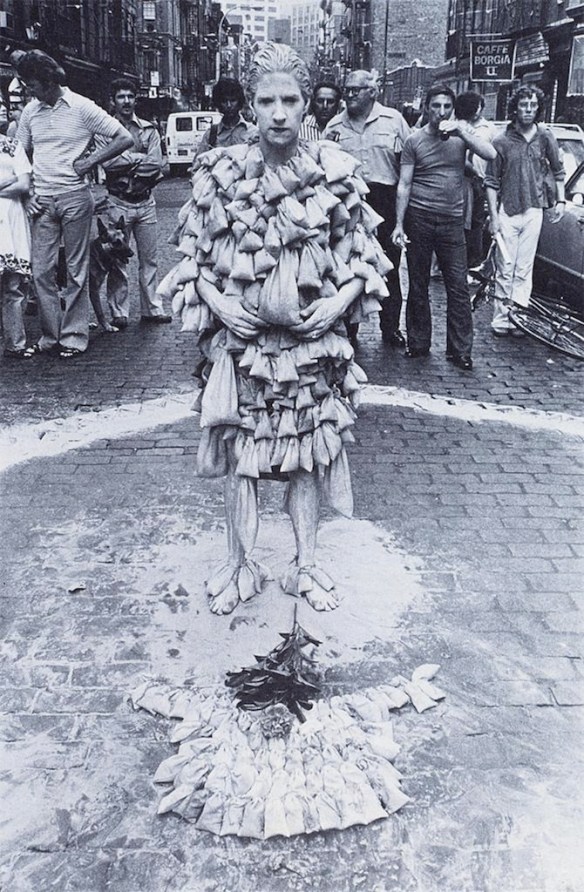
Betsy Damon, The 7,000 Year Old Woman, New York City, 1977. Photograph taken by Su Friedrich.

Above: an arresting and exhilarating photo by Su Friedrich of Betsy Damon’s performance piece in Jennie Klein’s “Goddess: Feminist Art and Spirituality in the 1970s.” Klein’s essay is one of many in the wide-ranging, informative, eclectic and breezy read, West of Center: Art and the Counterculture Experiment in America, 1965-1977, edited by Elissa Auther and Adam Lerner (Minneapolis: University of Minnesota Press, 2012).

Klein writes,

Betsy Damon’s The 7,000 Year Old Woman referenced the many-breasted Diana of Ephesus, associated with a Neolithic Goddess site in Turkey where she had lived as a child. Covered in small bags of colored flour that she ritualistically punctured in a public ceremony on Wall Street, Damon eventually formed a spiral/labyrinthine pattern on the ground. Damon based The 7,000 Year Old Woman on a dream that she had had years before. She resolved to realize the images in her dream.  (227)

Citizen Feminist

http://en.wikipedia.org/wiki/File:Pussy_Riot_by_Igor_Mukhin.jpg

When Vladimir Putin announced to international media outlets that Nadezhda Tolokonnikova, Maria Alekhina, and Yekaterina Samutsevich of Pussy Riot “shouldn’t be judged so harshly” and that he hoped the court decision will be “well-founded,” it became clear the women would receive a guilty sentence that would be the most of the least: just long enough to be onerous and just short enough to (hopefully) turn worldwide focus away from their plight.

There are two specific things about the events which have unfolded around Pussy Riot’s arrest that fascinate, provoke and inspire me, and which have been under-examined in reportage I’ve read:

1. The “attack” on Moscow’s Christ the Saviour Cathedral was only significant in so far as it supplied the staging and mise-en-scene for the music video which the group created–the one that, according to Tolokonnikova’s husband Pyotr Verzilov, got the members arrested. (Both versions of the footage here.) The trio was charged with “hooliganism” in name only; in reality, they had proven alarmingly effective counter-cultural advertisers, and were being prosecuted for it.

Although it’s easy to argue that every stage of this conflict (from provocation to show trial to “Free Pussy Riot” web platforms to this blog post) played out in the realm of the virtual, Pussy Riot must be lauded for their courage in allowing this virtual battle to inflict itself upon their own plane of immanence. History proves that this, and only this is the way activism “makes a difference.”

Moreover, in her lucid and brilliantly-engineered closing statement, Yekaterina Samutsevich pointedly connected Putin’s co-option of the Orthodox Church and the national media to Russia’s quotidian plane of immanence, as well:

That Christ the Savior Cathedral had become a significant symbol in the political strategy of the authorities was clear to many thinking people when Vladimir Putin’s former [KGB] colleague Kirill Gundyayev took over as leader of the Russian Orthodox Church. After this happened, Christ the Savior Cathedral began to be openly used as a flashy backdrop for the politics of the security forces, which are the main source of political power in Russia.

[…]

Implementing this thoroughly interesting political project has required considerable quantities of professional lighting and video equipment, air time on national television for hours-long live broadcasts, and numerous background shoots for morally and ethically edifying news stories, where the Patriarch’s well-constructed speeches would in fact be presented, thus helping the faithful make the correct political choice during a difficult time for Putin preceding the election. Moreover, the filming must be continuous; the necessary images must be burned into the memory and constantly updated; they must create the impression of something natural, constant, and compulsory.

Our sudden musical appearance in the Cathedral of Christ the Savior with the song “Mother of God, Drive Putin Out” violated the integrity of the media image that the authorities had spent such a long time generating and maintaining, and revealed its falsity. In our performance we dared, without the Patriarch’s blessing, to unite the visual imagery of Orthodox culture with that of protest culture, thus suggesting that Orthodox culture belongs not only to the Russian Orthodox Church, the Patriarch, and Putin, but that it could also ally itself with civic rebellion and the spirit of protest in Russia.

Translation from Chto Delat News, n+1

We can read here the clear influence of Guy Debord’s theory on Pussy Riot–indeed, Maria Alyokhina gives him a shout-out in her closing statement.

2. The charges themselves as well as the disapproval voiced against Pussy Riot are tinged with unmistakable gender bias, when not misogyny. Unsurprisingly, the Western press has called little attention to this. Major news outlets in the United States are naturally eager to report on the women as a.) anti-Putin activists and b.) colorfully-clad, winsome young women (just count the number of glamor shots of conventionally beautiful Tolokonnikova alone) but bulk at explaining the group’s larger and more systemic critique of patriarchy.

Witness the barely-veiled misogyny (and the prejudice against Judaism and Islam) in Putin’s less-reported follow-up comment that, had the women performed this act in “Israel” or “some sacred Muslim place,” well, “there are some pretty strong guys there, you know[…]we would not even have time to protect them.” Implicit here is the conviction that it might have been better if the three women had indeed been violently attacked by men–obviously they were ungrateful for the restraint Russian police had shown by not “giving them what they deserved.”

The offenses they were charged with (violating “conceivable and inconceivable rules,” emphatic vulgarity, “deliberately provocative” gesturing, parody and their clothing, “inappropriate in a church”) and the disapproving psychological evaluations they received (“proactive approach to life,” “a drive for self-fulfillment,” “stubbornly defending their opinion,” “inflated self-esteem,” “inclination to opposition behavior,” and “propensity for protest reactions”) are to my mind saturated in historic discrimination against women who dare to make a claim to power. Whores, shrews, slatterns, hysterics, bitches: these are the stereotypes latent here in the language of psychologist, judge, and prosecution.

Wisely, Pussy Riot didn’t make this maddening injustice the center of their closing statements. They had already accomplished the most forceful feminist act of the past several months by becoming for however short a time the sine qua non of vital leftist contestation. For the past several weeks, these women have demonstrated that, in contrast to the narratives put forward by “identity politics” disaffecteds, feminism does not detract from the wider struggle against state oppression, religious hypocrisy and capitalist hegemony, but is in fact a universal synecdoche for it. Importantly, the same can be said of artistic expression. This is at the heart of Maria Alyokhina’s closing statement…:

There is [currently in Russia] no “individual approach,” no study of culture, of philosophy, of basic knowledge about civic society. Officially, these subjects do exist, but they are still taught according to the Soviet model. And as a result, we see the marginalization of contemporary art in the public consciousness, a lack of motivation for philosophical thought, and gender stereotyping. The concept of the human being as a citizen gets swept away into a distant corner.

[…]

Today’s educational institutions teach people, from childhood, to live as automatons. Not to pose the crucial questions consistent with their age. They inculcate cruelty and intolerance of nonconformity. Beginning in childhood, we forget our freedom.

[…]

An artistic situation can and, in my opinion, must contain its own internal conflict.

Translated by Marijeta Bozovic, Maksim Hanukai, and Sasha Senderovich, n+1

…as well as Nadezhda Tolokonnikova’s closing statement:

Pussy Riot’s performances can either be called dissident art or political action that engages art forms. Either way, our performances are a kind of civic activity amidst the repressions of a corporate political system that directs its power against basic human rights and civil and political liberties. The young people who have been flayed by the systematic eradication of freedoms perpetrated through the aughts have now risen against the state. We were searching for real sincerity and simplicity, and we found these qualities in the yurodstvo [the holy foolishness] of punk.

Translation by Maria Corrigan and Elena Glazov-Corrigan, n+1

“The inner chronicle of what we are”

This clip is from the end of the documentary, Burden of Dreams (Les Blank and Maureen Gosling, 1982). In it, Werner Herzog tries to answer why art is so vital and so absurd, and what kind of sheer artist hubris is necessary to say so. In his face and his falsely casual body language, we see his pride and slight embarrassment mingle.

Herzog’s testament to art is echoed in Bernard Stiegler’s “The Tongue of the Eye: What “Art History” Means,” which I recently read in the very good Releasing the Image: From Literature to New Media (edited by Jacques Khalip and Robert MItchell, Stanford: Stanford University Press, 2011).
Stiegler writes,
To paint, to write (music, literature), to perform (music, theater), to stage and to install, is to take care of oneself–and consequently of others, and of the realm of others. The practices constituing this care, and that give acces to noetic organs (including the memory and brain that connect them), have been destroyed by the proletarization of the consumer subjected to the automatisms of a de-sublimated unconscious. This tends to make us return en masse–and as audiences–to the prenoetic, losing the ability to look [savoir regarder], trans-individuated by the ability to do [savoir-faire] and the ability to live [savoir-vivre] transmitted to us by painting and, broadly, by culture. For the culture industries and the psycho-technologies that they develop destroy the organological circuits supporting the processes of transindividuation (229).