Unknown's avatar

About Jennifer Stob

art and film historian

à tâtons

Two films in the Friday line-up at the NYFF’s Views from the Avant-Garde have had me flashing back to them the last couple of days. Both were puzzlers which kept audiences guessing on both the narrative and formal level. Both paid homage to the need to somehow move forward in an experimental state without clarity. Graspingly, stumblingly, failingly and yet wittily, continually.

One:

Film still from NYFF site

French film director Nicolas Rey seems marked by destiny to make wordplay films which expose an absolutely foreign, cerebral and uncanny side of familiar, corporeal, and melodramatic fare.

In Rey’s wonderful anders, Molussien (2012), French and German culture wrap together like a piece of twine: the tone of the film is Brecht doing a riff on La Fontaine, the differently-colored, nostalgic intertitles are ornamentally bi-lingual. The premise from which the film departs is twisted, too: Rey is an avid reader of Günther Anders’ essayistic writings, but opted to make a film with passages selected by someone else from one of Anders’ novels which remains untranslated (and therefore inaccessible, at least directly, to Rey).

The novel, Die molussische Katakombe, is told from the bowels of a prison by individuals huddled together in the darkness, speaking of a world gone wrong that used to exist (if there is such a thing as a post-dystopian literary genre, this seems to belong squarely to it). In the film, the plight of this former world is given to us in snippets only–terse, aphoristic exchanges which begin with satiric wit and often end with a dull ideological thud in the pit of the stomach. In a further, ingenious complication of this philosophical game of telephone, Rey intends for the various reels of the film to be projected in a randomly determined order. Michael Sicinski’s review on cinema-Scope.com nicely describes the odd sensation of open-and-closed-at-the-same-time that the film’s structural and textual logic produce in its viewers:

What is interesting about Rey’s treatment of reel randomization in autrement, la Molussie, I think, is that it enfolds the passages of Anders’ novel within a filmic time that is “flattened” or relegated to a universally applicable principle—it could be the first, the last, or some floating middle, a slice of what Deleuze might have called “any time whatever.” In this regard, Rey renegotiates the narrative time of The Molussian Catacomb into a kind of thinly spread simultaneity, an all-over “time field,” not unlike the colour field of a painter’s canvas. Not only does everything happen at once, but in a theoretical timeframe of perpetual diegetic present. The inescapable historical resonances within Anders’ imaginary tale of Molussia—to Nazi Germany, but to various other times including our own—all become equally present through Rey’s unusual presentation.

This is, of course, the same effect (in very different intervals) that still photography accomplishes in Chris Marker’s La jetée(1962). Rey’s film is shot on hand-me-down, aged Agfa-Gevaert stock, telling its story in grainy, desaturated imagery.

Two:

Film still from the NYFF site

Ferdinand Khittl’s Die Parallelstrasse (1961) is a nightmarish game show of a filmic conceit: five men have been charged with the task of ordering 300-something documents which appear to them and the film audience as audio-visual sequences of varying short lengths. The unknown amount of time the men have to complete this task is rapidly elapsing, and their feeble attempts at significational categorization break down repeatedly as the film progresses.

Their work is no match for the overwhelming richness of potential in the montage sequences, the most brilliant of which comes first, as a backwards “Kino-eye” revivification of slaughtered sheep, reborn in perversity by the magic of the voiceover. How can we make sense of this?” is the gist of one man’s complaint in response to the documentation. “It’s like asking directions and someone tells you to ‘go straight ahead until the path diverges into two roads, and then take the parallel road.'” The participants’ (and by proxy, the audience’s) dilemma becomes a formidable and triumphant testament to film’s ability to wheel and deal along with the most contemporary forms of new media.

Two or more separate thoughts linked together and juxtaposed with two ore more separate images: the possibilities, as both films show, are endless. Two roads diverged in a wood, and experimental film figured out how to take both.
L’Invention Collective

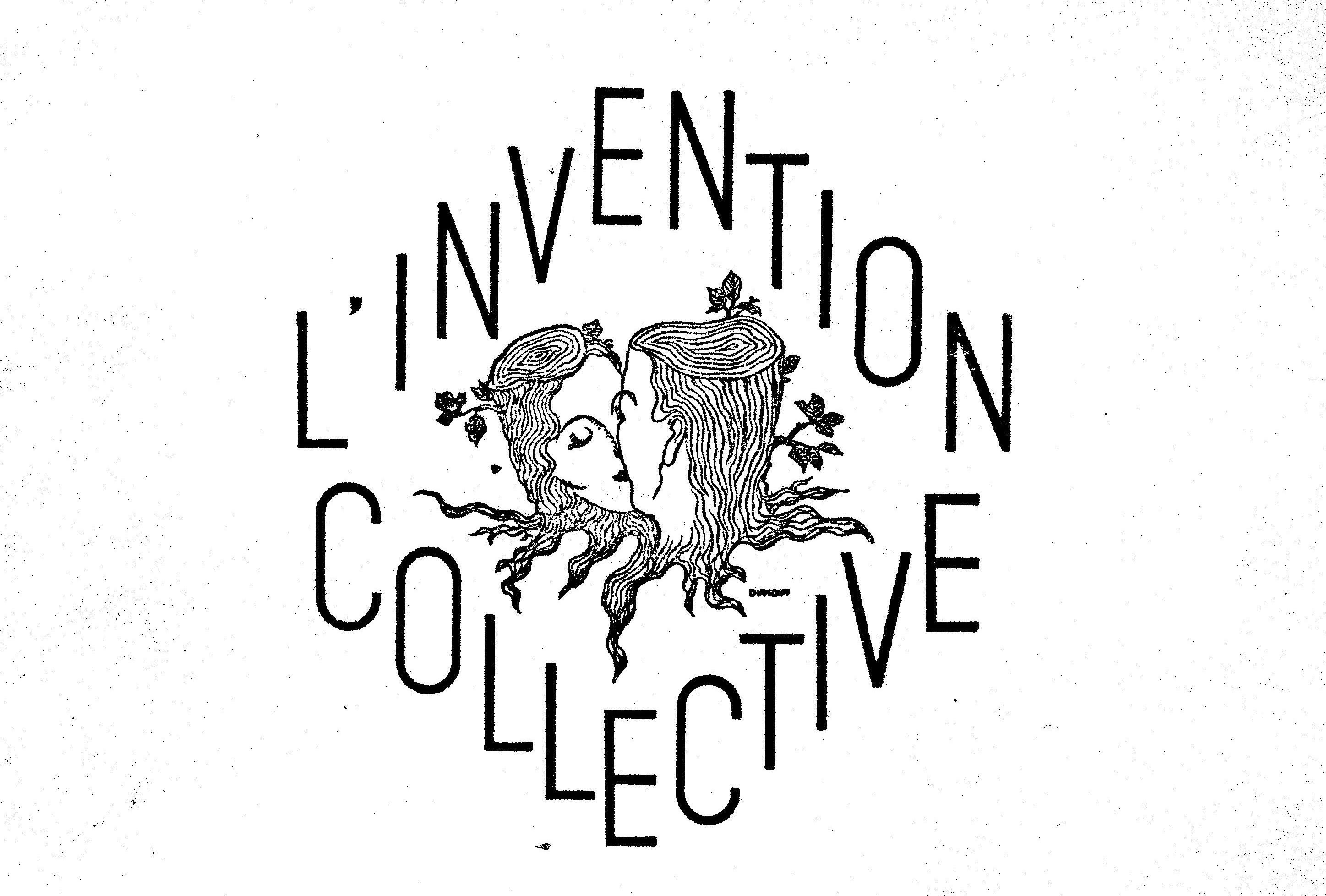
This image was the header of the Belgian surrealist journal, L’Invention Collective. The journal was short-lived; only two issues were published. Nevertheless, appearing as it did in the winter of 1940, it constituted perhaps the sole voice of surrealist creation during the Second World War. Paul Nougé was the journal’s editor.


R.I.P. WORM

Programmer extraordinaire and dear friend Peter Taylor writes with terrible news: WORM, the beloved “Institute for Avant-Garde Recreation” that made the year that I lived in Rotterdam so wonderful, has been shuttered, at least in its original form (scroll down for English).

Says Peter,

Just before the move to our new building in Rotterdam’s city centre last September, the national fund on which WORM depended for around 50% of her subsidy was scrapped. A fund with a wider remit was established as a replacement, but WORM’s application here was unsuccessful.

In June, WORM’s board and directors decided that the best response to this intensely difficult situation was to implement a plan to restructure, ending the work contracts of its programmers, and ceasing as a programme-creating organisation, beginning again in the New Year as a network and facilitating venue.

My work contract will end over the next few weeks and unfortunately, even with increased support from Rotterdam’s city council; WORM did not have the plan to reinstate this or any other programming positions.

What happens when cities casualize art workers and undercut the venues that showcase this work? Lives are dulled worldwide. Good art and those who advocate for it create a kind of butterfly effect in the art, hearts and minds of others:

Thanks to Peter’s risk-taking as a film programmer, I saw VALIE EXPORT’s Invisible Adversaries (1976) on a bitterly cold February (March?) night at their old Achterhaven space.

http://www.flickr.com/photos/terekhova/471393177/sizes/o/in/photostream/

The WORM as I knew it, in its Achterhaven space. Photo with kind permission from the Flickr stream of Terekhova

I loved the film, and began to study it. I traveled to Vienna to interview VALIE EXPORT, gave a talk on her film at 2012’s College Art Association Conference, and taught her to my students in the course, Art Since 1960. One ARTS major who wasn’t actually in my course heard me talk about EXPORT, and decided to write his final research paper on her. I’m now finishing an article on the film. The gift of a 6-euro screening had a ripple effect from Rotterdam to upstate New York to Vienna to Los Angeles.

What happens when cities casualize art workers and undercut the venues that showcase this work? I hope what happens is that Rotterdammers and their friends demand that art back. I don’t know the complexities involved in the city council’s decision to slash arts funding, but I do know that if they would honor the promise they originally made WORM when it moved venues, I would donate generously to its survival.

Peter puts it best:

Please keep on telling me, telling my colleagues, telling each other and telling strangers that you find this quest to confront audiences – week in, week out – with the boring, the thought-provoking, the absurd, the subversive, and the sublime, absolutely essential. Hopefully then, we can still get somewhere together!

Nixon/Agnew

Emory Douglas, Nixon/Agnew, from Black Panther newspaper. Offset lithograph. Copyright 2009 Emory Douglas/Artists Rights Society (ARS), New York.

As the Republican National Convention kicks off in Tampa, FL…

Emory Douglas’s psychedelic-and-engagé graphic art.

This was another discovery from West of Center: Art and the Counterculture Experiment in America, 1965-1977.

Here is Colette Gaiter’s description of the above print, from her essay, “The Revolution Will Be Visualized: Black Panther Artist Emory Douglas” in the compilation:

Collage was one of Douglas’s most favored techniques. In the Richard Nixon/Spiro Agnew image, he juxtaposed a photograph of the Republican nominees celebrating their ticket (from the cover of Time magazine on August 16, 1968) with images of anguished black people[…]Douglas’s collage alludes to controversial perceptions that the Nixon administration neglected problems of the urban, mostly black, poor. (246)

The 7,000 Year Old Woman

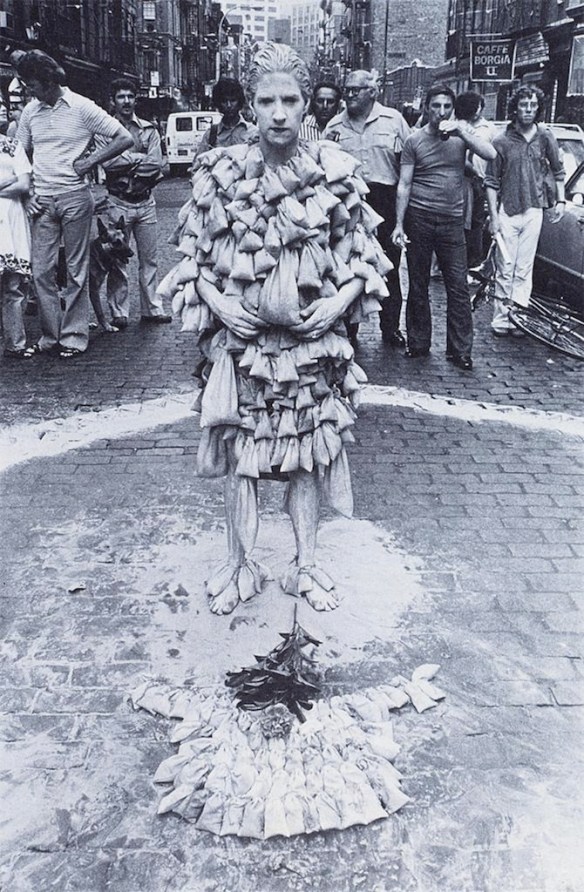
Betsy Damon, The 7,000 Year Old Woman, New York City, 1977. Photograph taken by Su Friedrich.

Above: an arresting and exhilarating photo by Su Friedrich of Betsy Damon’s performance piece in Jennie Klein’s “Goddess: Feminist Art and Spirituality in the 1970s.” Klein’s essay is one of many in the wide-ranging, informative, eclectic and breezy read, West of Center: Art and the Counterculture Experiment in America, 1965-1977, edited by Elissa Auther and Adam Lerner (Minneapolis: University of Minnesota Press, 2012).

Klein writes,

Betsy Damon’s The 7,000 Year Old Woman referenced the many-breasted Diana of Ephesus, associated with a Neolithic Goddess site in Turkey where she had lived as a child. Covered in small bags of colored flour that she ritualistically punctured in a public ceremony on Wall Street, Damon eventually formed a spiral/labyrinthine pattern on the ground. Damon based The 7,000 Year Old Woman on a dream that she had had years before. She resolved to realize the images in her dream.  (227)

Citizen Feminist

http://en.wikipedia.org/wiki/File:Pussy_Riot_by_Igor_Mukhin.jpg

When Vladimir Putin announced to international media outlets that Nadezhda Tolokonnikova, Maria Alekhina, and Yekaterina Samutsevich of Pussy Riot “shouldn’t be judged so harshly” and that he hoped the court decision will be “well-founded,” it became clear the women would receive a guilty sentence that would be the most of the least: just long enough to be onerous and just short enough to (hopefully) turn worldwide focus away from their plight.

There are two specific things about the events which have unfolded around Pussy Riot’s arrest that fascinate, provoke and inspire me, and which have been under-examined in reportage I’ve read:

1. The “attack” on Moscow’s Christ the Saviour Cathedral was only significant in so far as it supplied the staging and mise-en-scene for the music video which the group created–the one that, according to Tolokonnikova’s husband Pyotr Verzilov, got the members arrested. (Both versions of the footage here.) The trio was charged with “hooliganism” in name only; in reality, they had proven alarmingly effective counter-cultural advertisers, and were being prosecuted for it.

Although it’s easy to argue that every stage of this conflict (from provocation to show trial to “Free Pussy Riot” web platforms to this blog post) played out in the realm of the virtual, Pussy Riot must be lauded for their courage in allowing this virtual battle to inflict itself upon their own plane of immanence. History proves that this, and only this is the way activism “makes a difference.”

Moreover, in her lucid and brilliantly-engineered closing statement, Yekaterina Samutsevich pointedly connected Putin’s co-option of the Orthodox Church and the national media to Russia’s quotidian plane of immanence, as well:

That Christ the Savior Cathedral had become a significant symbol in the political strategy of the authorities was clear to many thinking people when Vladimir Putin’s former [KGB] colleague Kirill Gundyayev took over as leader of the Russian Orthodox Church. After this happened, Christ the Savior Cathedral began to be openly used as a flashy backdrop for the politics of the security forces, which are the main source of political power in Russia.

[…]

Implementing this thoroughly interesting political project has required considerable quantities of professional lighting and video equipment, air time on national television for hours-long live broadcasts, and numerous background shoots for morally and ethically edifying news stories, where the Patriarch’s well-constructed speeches would in fact be presented, thus helping the faithful make the correct political choice during a difficult time for Putin preceding the election. Moreover, the filming must be continuous; the necessary images must be burned into the memory and constantly updated; they must create the impression of something natural, constant, and compulsory.

Our sudden musical appearance in the Cathedral of Christ the Savior with the song “Mother of God, Drive Putin Out” violated the integrity of the media image that the authorities had spent such a long time generating and maintaining, and revealed its falsity. In our performance we dared, without the Patriarch’s blessing, to unite the visual imagery of Orthodox culture with that of protest culture, thus suggesting that Orthodox culture belongs not only to the Russian Orthodox Church, the Patriarch, and Putin, but that it could also ally itself with civic rebellion and the spirit of protest in Russia.

Translation from Chto Delat News, n+1

We can read here the clear influence of Guy Debord’s theory on Pussy Riot–indeed, Maria Alyokhina gives him a shout-out in her closing statement.

2. The charges themselves as well as the disapproval voiced against Pussy Riot are tinged with unmistakable gender bias, when not misogyny. Unsurprisingly, the Western press has called little attention to this. Major news outlets in the United States are naturally eager to report on the women as a.) anti-Putin activists and b.) colorfully-clad, winsome young women (just count the number of glamor shots of conventionally beautiful Tolokonnikova alone) but bulk at explaining the group’s larger and more systemic critique of patriarchy.

Witness the barely-veiled misogyny (and the prejudice against Judaism and Islam) in Putin’s less-reported follow-up comment that, had the women performed this act in “Israel” or “some sacred Muslim place,” well, “there are some pretty strong guys there, you know[…]we would not even have time to protect them.” Implicit here is the conviction that it might have been better if the three women had indeed been violently attacked by men–obviously they were ungrateful for the restraint Russian police had shown by not “giving them what they deserved.”

The offenses they were charged with (violating “conceivable and inconceivable rules,” emphatic vulgarity, “deliberately provocative” gesturing, parody and their clothing, “inappropriate in a church”) and the disapproving psychological evaluations they received (“proactive approach to life,” “a drive for self-fulfillment,” “stubbornly defending their opinion,” “inflated self-esteem,” “inclination to opposition behavior,” and “propensity for protest reactions”) are to my mind saturated in historic discrimination against women who dare to make a claim to power. Whores, shrews, slatterns, hysterics, bitches: these are the stereotypes latent here in the language of psychologist, judge, and prosecution.

Wisely, Pussy Riot didn’t make this maddening injustice the center of their closing statements. They had already accomplished the most forceful feminist act of the past several months by becoming for however short a time the sine qua non of vital leftist contestation. For the past several weeks, these women have demonstrated that, in contrast to the narratives put forward by “identity politics” disaffecteds, feminism does not detract from the wider struggle against state oppression, religious hypocrisy and capitalist hegemony, but is in fact a universal synecdoche for it. Importantly, the same can be said of artistic expression. This is at the heart of Maria Alyokhina’s closing statement…:

There is [currently in Russia] no “individual approach,” no study of culture, of philosophy, of basic knowledge about civic society. Officially, these subjects do exist, but they are still taught according to the Soviet model. And as a result, we see the marginalization of contemporary art in the public consciousness, a lack of motivation for philosophical thought, and gender stereotyping. The concept of the human being as a citizen gets swept away into a distant corner.

[…]

Today’s educational institutions teach people, from childhood, to live as automatons. Not to pose the crucial questions consistent with their age. They inculcate cruelty and intolerance of nonconformity. Beginning in childhood, we forget our freedom.

[…]

An artistic situation can and, in my opinion, must contain its own internal conflict.

Translated by Marijeta Bozovic, Maksim Hanukai, and Sasha Senderovich, n+1

…as well as Nadezhda Tolokonnikova’s closing statement:

Pussy Riot’s performances can either be called dissident art or political action that engages art forms. Either way, our performances are a kind of civic activity amidst the repressions of a corporate political system that directs its power against basic human rights and civil and political liberties. The young people who have been flayed by the systematic eradication of freedoms perpetrated through the aughts have now risen against the state. We were searching for real sincerity and simplicity, and we found these qualities in the yurodstvo [the holy foolishness] of punk.

Translation by Maria Corrigan and Elena Glazov-Corrigan, n+1

“The inner chronicle of what we are”

This clip is from the end of the documentary, Burden of Dreams (Les Blank and Maureen Gosling, 1982). In it, Werner Herzog tries to answer why art is so vital and so absurd, and what kind of sheer artist hubris is necessary to say so. In his face and his falsely casual body language, we see his pride and slight embarrassment mingle.

Herzog’s testament to art is echoed in Bernard Stiegler’s “The Tongue of the Eye: What “Art History” Means,” which I recently read in the very good Releasing the Image: From Literature to New Media (edited by Jacques Khalip and Robert MItchell, Stanford: Stanford University Press, 2011).
Stiegler writes,
To paint, to write (music, literature), to perform (music, theater), to stage and to install, is to take care of oneself–and consequently of others, and of the realm of others. The practices constituing this care, and that give acces to noetic organs (including the memory and brain that connect them), have been destroyed by the proletarization of the consumer subjected to the automatisms of a de-sublimated unconscious. This tends to make us return en masse–and as audiences–to the prenoetic, losing the ability to look [savoir regarder], trans-individuated by the ability to do [savoir-faire] and the ability to live [savoir-vivre] transmitted to us by painting and, broadly, by culture. For the culture industries and the psycho-technologies that they develop destroy the organological circuits supporting the processes of transindividuation (229).

The wit of the cinematographer

http://www.luxonline.org.uk/artists/peter_gidal/condition_of_illusion.html

Still from Peter Gidal’s The Condition of Illusion, 1975

I came across this witheringly funny exchange between Jean-Louis Comolli and Peter Gidal today, going through my piles of library books that I should have returned in July. (The pleasure of the overdue text!)

Comolli goes for the low-hanging fruit in his first (and more so, his last) statement. The first two issues he raises can easily be put to rest by a consideration of the phenomenological experience of experimental film–specifically, the kind of endurance it exacts from a viewer and the way in which experimental film makes us notice thinking as both time-based and spatial.

Gidal is having none of it; he responds with the first in a series of pithy glove-slaps, in the best tradition of a nobleman duelist.

Comolli rallies and tries to hit from yet a third and forth angle. (It’s always a sign that you’re losing the debate if you need to keep shifting the terms of engagement.) Nonetheless, these third and fourth points raised are far more thought-provoking. To me they are indicative of the French/Anglo-American divide in the approach to cinema as unquestionably one of the arts in its own right (the former) versus cinema as a medium that must justify its inclusion in those ranks, ignorant of the history of the arts all the while (the latter).

In his last point (a professor decrying the cinema by and for professors), Comolli seems to have fallen straight into the social realist allusion Gidal makes.

But read for yourself, much more entertaining than my play-by-play:

Jean-Louis Comolli: I should like to come in on the question of avant-garde film, remembering particularly some of the films we have just seen, such as Gerson’s Luminous Zone or Gidal’s Condition of Illusion[…]The first point I want to make is that all these films, differently but equally, play on optical effects; which leads to an effect of fascination on the spectator whose look is held by a dispositif that gives him or her spectacle to be seen. Even if that spectacle is not an analogical figuration of the real, it is no less of the order of the visible; the visible is not simply figured analogically, it is also abstract visible, non-figurative visible. For me then, there is in these films the risk not of reposing the questions of the traps of the ideology of the visible but, on the contrary, of valorising, multiplying, finally rendering triumphant that ideology of the visible in which we are caught. A second point is that these films or certain parts of these films–but this is not the case with Riddles of the Sphinx, for example–seem to me to work on a very simple principle, that of the small-scale theoretical model: there is a theory at the beginning of the film, a set of theoretical positions that the film applies, and when the film is over, the same theoretical themes are there, the same theoretical propositions serve to read the film. Thus what one has is a consumption in which the signifiers of the film are consumed in a prior knowledge and a posterior knowledge which are exactly the same–in other words, these are ‘texts’ in which few things are transformed, or even nothing at all.

Gidal: You must be blind.

Comolli: I am blind and we are all blind. A further point is that avant-garde movement of these films supposes an absolute domination of certain cinematic forms and I wonder if this is really the case, I wonder if we are still in a historical moment of the domination absolutely of a particular cinematic form. My own belief is that, on the contrary, we are in a moment in which different cinematic forms have appeared which compete with the dominant Hollywood form and that this kind of avant-garde cinema is in some way a little behind. What one might have been able to think of as necessary between the thirties and fifties, when the imperialism of Hollywood forms was precisely massive and powerful, is less so today; the avant-garde has a history in the history of cinema but that history is thought ahistorically, is not articulated to the different contradictions and transformations, tot he changes in the balance of power between historical forms of cinema[…]Peter Gidal’s Condition of Illusion does not think its relation to a certain form of abstract painting, or at least proceeds as though what has already been gained in the modifications of codes of representation by painting was not gained for cinema; just as in Barry Gerson’s Luminous Zone, the exercise in framing, everything seems to go on as though the work of Mondrian had been to no purpose.

Gidal: Eight words: it sounds like Radek’s speech against James Joyce.

Comolli: No, I think not, I am raising problems, questions that need to be worked through toward a different kind of discussion. One more remark, however. With regard to the films that we have seen, I have the feeling that what is involved is a particular kind of cinema that might be called a cinema by and for professors. The word “professor” brings with it the question of power, the power of the person who as the knowledge–a question that is apparently never posed by the subjects who make the these films. “Professor” can also be specified by the term “doctor”: these are films by and for doctors, “doctor” in the double sense of possessor of learning and person who gives medical treatment.

Gidal: Doctors also take out sutures.

From The Cinematic Apparatus, Edited by Teresa de Lauretis and Stephen Heath (New York: St. Martin’s Press, 1980), 170-171

Makes me proud to be a doctor.