Unknown's avatar

About Jennifer Stob

art and film historian

Es sind lauter Widerstände von Anfang an

I found this funny, minimal, inventive and very moving film two weeks ago and was swallowed up whole (not a common Youtube viewing occurrence). Between 16mm and video recording for television, Ferry Radax performs a respectful, absurdist, and elegant pas de deux with Austrian novelist, poet, playwright and saint of the negative Thomas Bernhard.

Of the many brutal yet ornamental and telegrammatically-spoken thoughts Bernhard shares, I especially appreciated the one I’ve tried to translate below. Darkly hilarious and reluctantly tender. It brought my attention to the German word Widerstand, which I had always understood as “resistance,” but which Bernhard uses here equally in the sense of “antagonism,” “opposition” and “obstruction.” From around the 16:30 mark:

There’s plenty of oppositions from the very beginning, probably always have been. Oppositions, what is opposition? Opposition is material. The brain needs oppositions. By amassing oppositions, it has material.

Opposition? Oppositions. Opposition, when you peer through a window, opposition when you should write a letter–you just don’t want to do it–you receive a letter, another opposition [wieder ein Widerstand]. You say to hell with it–nevertheless, you answer at some point.

You walk outside, you buy something, you drink a beer, it’s all such a bother, all that is opposition. You get sick, go to the hospital, there are complications–again opposition [wieder Widerstand]. Suddenly chronic illnesses surface, go away again, linger–oppositions, of course. You read books–oppositions. You don’t want any books, you don’t want any thoughts, either, you don’t want language or words, no sentences, you don’t want any history–you want absolutely nothing. Nevertheless, you fall asleep, you wake up. The result of falling asleep is waking up, the result of waking up is standing up. You must stand up against all oppositions.

You must leave the bedroom, the newspaper appears, sentences appear, always the same sentences, actually–you don’t know where they come from–uniformity, right? From it new oppositions arise again, from all that you notice. Actually, you want nothing more than to sleep, to be ignorant of it all. Then suddenly, once again the desire to…

Reprise

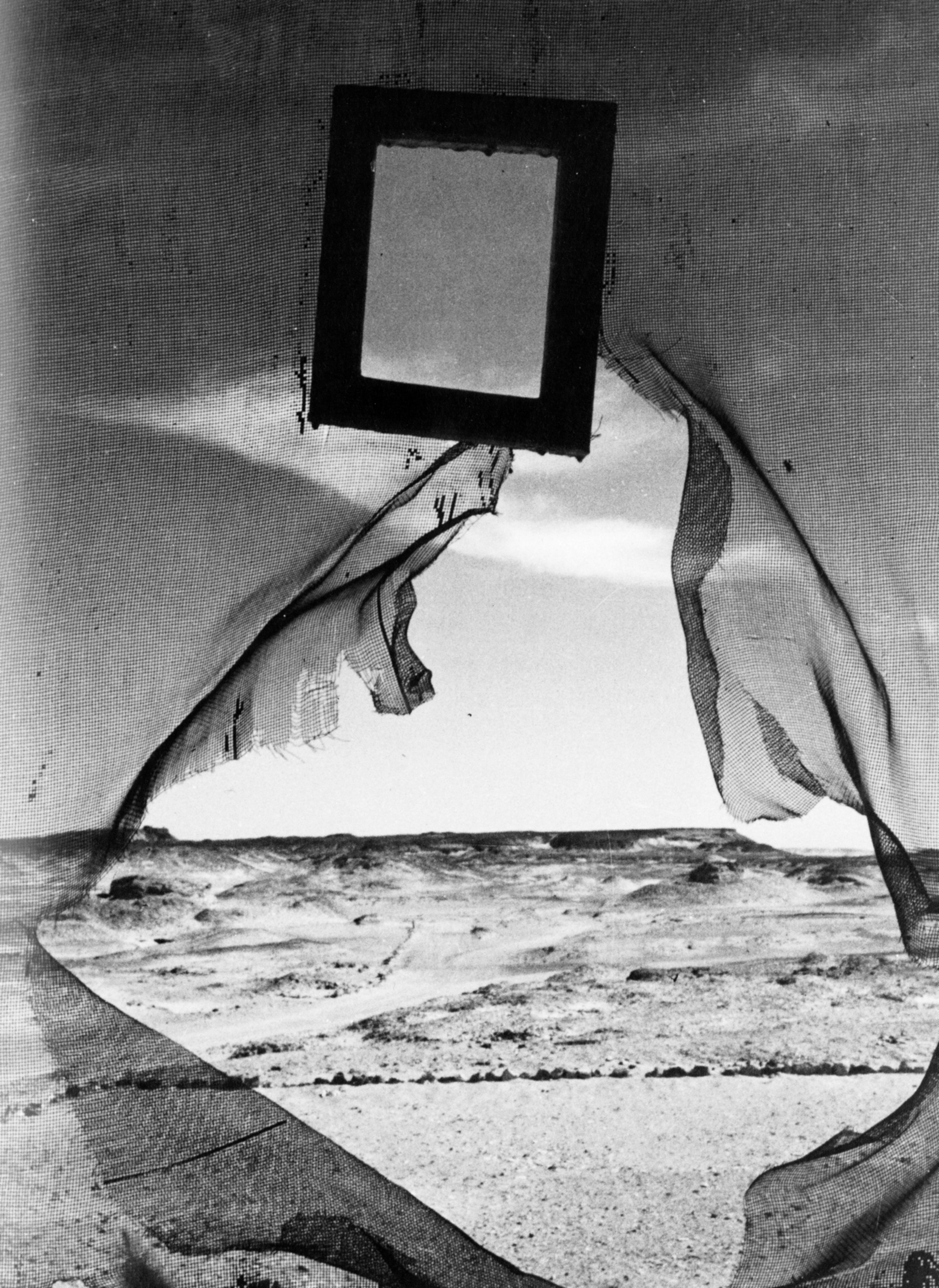
Lee Miller, Portrait of Space, 1937. Gelatin silver print. 13.3 x 12.4 cm.

Lee Miller, Portrait of Space, 1937. Gelatin silver print. 13.3 x 12.4 cm.

A Lee Miller photograph as an overture to sporadic summertime posting!

Miller made this photograph while visiting the Siwa Oasis in Egypt. She took it from inside an abandoned bungalow belonging to traveling officials.

On the recently established website dedicated to her archives, you can see the original snapshot from which she cropped and enlarged this image. The archive is fascinating to click through, even if the images are irritatingly (if self-explanatorily) watermarked for viewing unpleasure.

Miller described the rectangle sewn into the screen as what would have earlier been an opening used to “reach through the mosquito netting to latch or unlatch the sand storm shutters” (in Mark Haworth-Booth, The Art of Lee Miller, New Haven, Yale University Press, 2007, p. 133).

By the time she entered the bungalow, this original opening had been made accessory to the beautiful rent beneath it. Space’s portrait is only ever its frame.

Watching “The Clock”

Christian Marclay, THE CLOCK, 2010. Image accessed at http://www.torontolife.com/daily/wp-content/uploads/2012/09/sept12TheArgument.jpg

At SCMS ’13 in Chicago this weekend, I noticed a panel entirely devoted to Christian Marclay’s 24-hour, single channel computer program, The Clock. The artwork is a massive compilation of sequences from film history which feature time-keeping and time-breaking: clocks, watches, alarms, bombs and digitized displays as silent witnesses and narrative fulcrums. I missed the panel, as one is forced to do at a conference as massive as SCMS, but I thought I’d use it as an impetus to write some thoughts on the artwork that I had had earlier this year.

I read the glowing portrait of Marclay and the project that Daniel Zalewski had painted in a 2012 issue of the New Yorker, and (contrarian by nature), immediately knew I had to see it for myself. I did so during its run at the MoMA (December 21, 2012–January 21, 2013). I chose the worst possible time: at closing on a Target Free Friday Night. Stomach growling, wait time estimated at one hour, my partner and I shrugged at each other. At least we were getting the full experience.

After a faithfully estimated hour of chit chat and eavesdropping on the decreasingly interesting chit chat of surrounding art goers, we entered the darkened gallery space. By the light of the screen, I saw (much to my loathing and delight) that the vast space was ordered with rows of IKEA KLIPPAN sofas. Is there a better candidate for a penultimate Benjaminian dialectical image/object of the early years of the 21st century?

I thought it was interesting that from its installation concept, Marclay’s Clock seems to place itself more in a history of TV viewing than movie-going (the relatively small size and low placement of the screen, the unraked floor, cushy seating). Several spectators were sprawled out on their backs or stomachs like children in front of a giant set. We sat on the floor in the crowded makeshift theater for about ten minutes, then finally a sofa freed up.

As I had expected, I didn’t like the piece, but I found it fascinating. For a film and media studies scholar (especially one trained in a more conservative fashion) the cinephiliac mode of trying to identify each sequence used was taxing. I had to keep reminding myself that it wasn’t a qualifying exam. As I let myself slide along the endless montage of graphic matches, I started mentally playing with common themes and parallels from minute to minute. We were there from about 9pm to 10:45pm, long after nuclear family dinnertime and too soon for the 2am phone calls with bad news. During this stretch of Movieland night, three principle activities take place: 1.) bodies are discovered. 2.) women get stood up for dates. 3.) people don’t come home, and whomever is expecting them paces nervously.

In this segment of The Clock, Marclay’s army of young, vision-ruined assistants were using overwhelmingly English-language, Hollywood, genre-based films as their raw material. That was disappointing–I would have liked a little armchair tourism with my time travel. Perhaps, I thought, there is something about Anglophone culture (capitalist industrialization its hallmark) that makes its cinema rely more heavily than others on codified and disciplined segments of day for narrative meaning. Productivity, efficiency, quota fulfillment, happy ending!

After an hour, I was restless. For me, the sensation of watching The Clock was one of enervation. I felt mildly depressed at the virtual drain on my nightlife. My partner, however, didn’t want to leave. In fact, relatively few people seemed to leave during the our stay–everyone seemed absorbed, transfixed. By what?, I wondered. Perhaps they, like us, wanted to watch at least as long as they had waited to watch? Of The Clock, Rosalind Krauss writes that Marclay turns to “suspense as the extended dilation of [Hüsserl’s] ‘now effect,’ transforming the reel time of film into the real time of waiting.” (Krauss, “Clock Time,” October 136, Spring 2011, pp. 213–217.) While it makes for a nice pun, I disagree with Krauss–I don’t think The Clock is about the filmic, unless its about film’s afterlife. To me, the piece diffuses suspense and is instead about an ecstatic seriality, endless citation. It is about the soothing pleasure of the familiar unfamiliar. About knowing what will happen next but not knowing how, exactly.

The most rewarding thing about the experience was the walk to get dinner afterward. All of a sudden, every idle gesture of looking at clocks in building facades or at our wrist watches or cell phones had become overdetermined. Like a dramatic kiss or a particularly good insult hurled, the glance at the time was now cinematic for us, part of a catalogue of experience for which moving images condition us. We had never noticed before.
The fringe of American-in-Tehran-ness

A quick bit of Oscar peevishness: skimming through Nate Silver’s Oscar predictions, it looks like Argo is a shoe-in for Best Picture. A shame, I think.

ARGO, Ben Affleck, 2012. Image accessed at http://boxofficemojo.com/image2/argo_argo35.jpg

I saw the film last month, and walked out of the theater shaking my head at the missed opportunity it represented: the Iran hostage crisis (shot in Turkey)! Six bumbling escapees! A CIA exfiltration specialist! A faux orientalist sci-fi movie as cover-up! And of course, best of all, rescue Canadians!

What absolutely reactionary use of endlessly fascinating material. I sat up straight for the first forty minutes of film, waiting expectantly for the story to get weirder and weirder. After all, much of the narrative build-up in the first “act” is so cliche (the painstakingly and lifelessly reenacted protest tumult, the whole “father in a problem marriage estranged from innocent son” trope, the terrible scoring) that it could have easily served as the trigger for a truly marvelous extended mise-en-abyme.

I imagined a demonstratively fake film (featuring Americans in jeopardy in the treacherous Middle East)…about the faking of a film intended to help Americans in jeopardy in the treacherous Middle East. But aside from a few careful jokes (“Marx said, ‘history repeats itself, the first time as tragedy and the second time as farce'”) the film is far too timid to go all the places it could have gone. Speaking of Breathless in 1968, Jean-Luc Godard quipped, “I thought that I had filmed Son of Scarface or Return of Scarface, and I realized [when I saw it for the first time] that I had actually made Alice in Wonderland, more or less.”

As lovely a moral tale as Godard had crafted for himself in his political modernist phase with that statement, anyone who has seen Breathless knows that Godard had this realization while shooting. He shows us his emulation, then his failure, and how an entirely new and electrifying film form has resulted from the process. In the hands of someone a good deal more brilliant and a great deal moins lâche, Argo could have been a vastly superior Tabu.

When Ben Affleck takes the podium to thank the Academy for his Best Picture award, I’ll be thinking of him in brownface in his film, his ridiculous bangs in his eyes and his lips slightly parted in quiet Everyman competency. I’ll think of Roland Barthes’ “The Romans in Films” from Mythologies (1957). Like the fringed hairdos of the ancient Romans in  Joseph Mankiewicz’s Julius Cesar (1953) the obsessive attention to historicized mise-en-scene in Argo reveals its inferiority complex to careful spectators.

We therefore see here the mainstream of the Spectacle — the sign —operating in the open. The frontal lock overwhelms one with evidence, no one can doubt that he is in Ancient Rome. And this certainty is permanent: the actors speak, act, torment themselves, debate “questions of universal import,” without losing, thanks to this little flag displayed on their foreheads, any of their historical plausibility. Their general representativeness can even expand in complete safety, cross the ocean and the centuries, and merge into the Yankee mugs of Hollywood extras: no matter, everyone is reassured, installed in the quiet certainty of a universe without duplicity, where Romans are Romans thanks to the most legible of signs: hair on the forehead (26).

The corduroys and the glasses and the late-seventies hair “overshoot the target and discredit themselves by letting their aim clearly appear” (26). If only Affleck had overshot farther still!

Freud’s “House Beautiful”

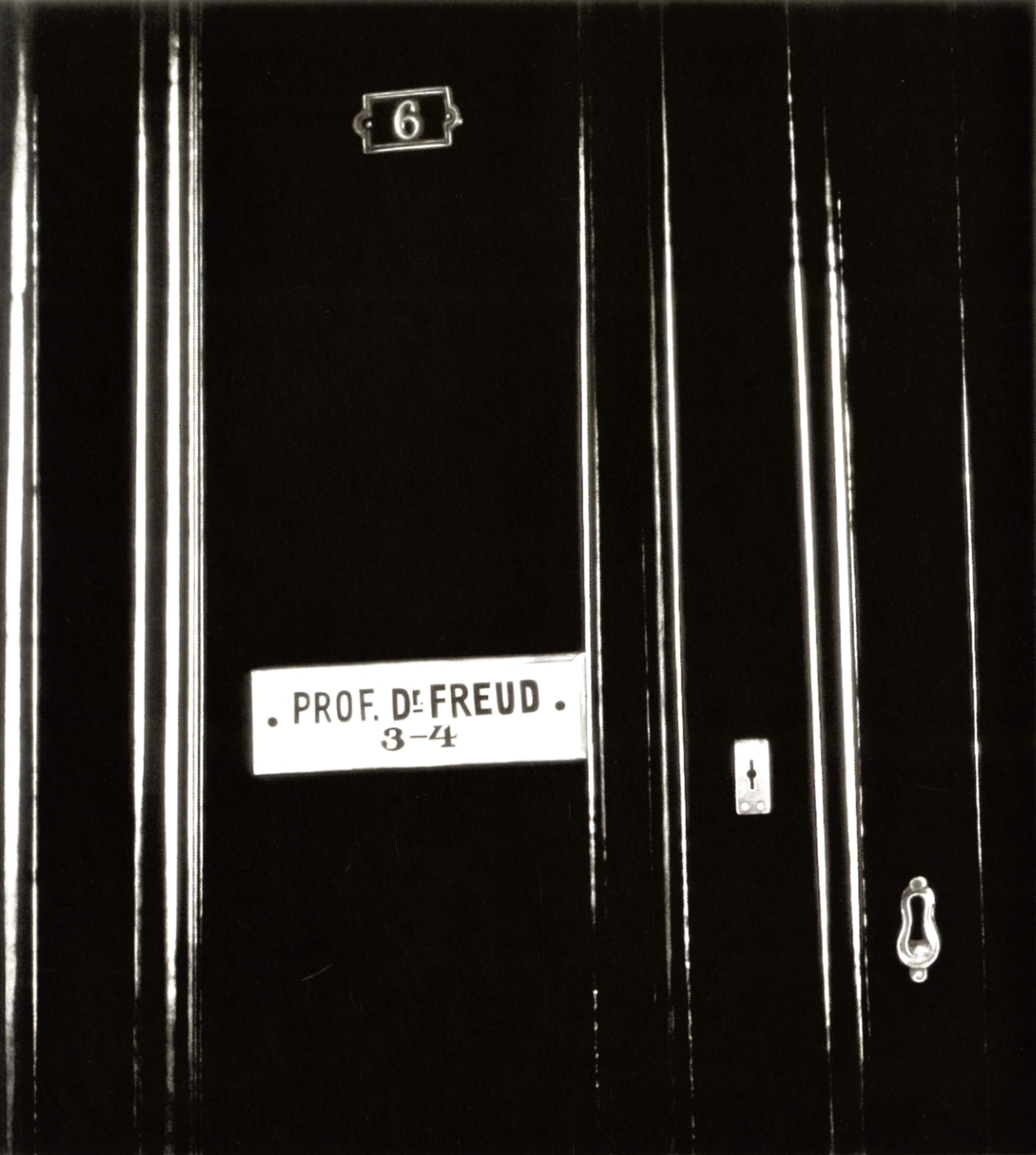
Some scans of Sigmund Freud’s home and psychoanalytic practice at Berggasse 19, from the book The Surreal House (ed. Jane Alison, Yale, 2010).

The first two are photographs from the famous series that Edmund Engelman made just before Freud had to flee Vienna in 1938. Of particular interest to me, amidst the mixed statuettes from China, Greece, and Egypt, is the mirror hung from the crossframe of Freud’s window. The id juxtaposed with the ego?

After that are selections from a series of velvety graphite and charcoal drawings of Engelman’s photographs by Robert Longo. The last two are outside of the interior. They are meant to be displayed as a diptych. Longo’s drawings uncannily translate the photographs (indexes of Freud’s psychoanalytic practice) back to the work of the hand, perhaps the metonymic subject of psychoanalysis itself.

I imagine Freud will soon be the focus of another round of scholarly inquiry (perhaps artistic inquiry, too). It seems that there are many more opportunities for turning his schemas and theories on their head in the way that feminist scholarship did in the 1980s and 1990s, aided in part by translations and compilations like Elisabeth Young-Bruehl’s Freud on Women

Sigmund Freud's apartment, Berggasse 19, Vienna, View of the writing desk in the study, 1938. Edmund Engelman. Photograph.

Sigmund Freud’s apartment, Berggasse 19, Vienna, View of the writing desk in the study, 1938. Edmund Engelman. Photograph.

Sigmund Freud's apartment, Berggasse 19, Vienna, View of the study, 1938. Edmund Engelman. Photograph.

Sigmund Freud’s apartment, Berggasse 19, Vienna, View of the study, 1938. Edmund Engelman. Photograph.

Untitled (Viennese porcelain stove (stretched), consulting room, 1938), Robert Longo, 2000. Graphite and charcol on mounted paper. 274 x 86 cm.

Untitled (Viennese porcelain stove (stretched), consulting room, 1938), Robert Longo, 2000. Graphite and charcoal on mounted paper.

Untitled (open door, consulting room to study, 1938). Robert Longo. 2000. Graphite and charcoal on mounted paper.

Untitled (open door, consulting room to study, 1938). Robert Longo. 2000. Graphite and charcoal on mounted paper.

Untitled (Diptych--Exterior Apartment Door with Nameplate and Peephole, 1938). Robert Longo. 2000. Graphite and charcoal on mounted paper.

Untitled (Diptych–Exterior Apartment Door with Nameplate and Peephole, 1938). Robert Longo. 2000. Graphite and charcoal on mounted paper.

Untitled (Diptych--Exterior Apartment Door with Nameplate and Peephole, 1938). Robert Longo. 2000. Graphite and charcoal on mounted paper.

Untitled (Diptych–Exterior Apartment Door with Nameplate and Peephole, 1938). Robert Longo. 2000. Graphite and charcoal on mounted paper.

Paris belongs to us

http://www.youtube.com/watch?v=Pv_FhRDaRSA&feature=youtu.be

A tantalizing little sequence of above-it-all from René Clair’s Paris qui dort / The Crazy Ray (1923). Entire film here. Lucky enough to have escaped the “crazy ray” of a conniving scientist who has frozen le tout Paris, the caretaker of the Eiffel Tower, four fashionable airplane passengers and their pilot cavort happily in the Trocadéro fountain and light each other’s cigarettes whilst hanging from the tower’s iron lattice. What power and liberty in the view from above, which endlessly fixes, distances and aestheticizes.

Poetry from the trenches

Going to MoMA’s current exhibition, “Inventing Abstraction: 1910-1925” was like a French New Year’s feast with a boggled mind afterward instead of a groaning belly: there was fois gras. There were oysters. Champagne, white wine, red wine, digestif. Lobster, roast, and quail. And of course, the moelleux.

Discoveries for me were:

Josef Albers’ Gitterbild (1921), a droll and clever teaching tool that transformed wire and industrial glass samples into a modernist study of color resonance and texture,

a whole wall of Kasimir Malevich’s Suprematist compositions–abstract portraits, landscapes and still lifes,

a 1979 reconstructed model of Vladimir Tatlin’s Monument to the Third International (1920), which sat ambitiously and quite uneasily in the gallery, surrounded by other Constructivist masterworks

and

Suzanne Duchamp’s Solitude entonnoir (1921), which entered into melancholy conversation with all of the grinders and rotaries and mills in the work of brother Marcel (dutifully represented in painting, sculpture and cinema).

The most extraordinary, however, was an extremely rare copy of Guillame Apollinaire’s Case d’Armons (1915). Apollinaire published the (I believe) hand-bound booklet of 21 poems on graph paper with the help of two sergeant friends from the trenches during the First World War. The booklet sat in a vitrine, covered by a velvet powder blue cloth. Visitors approached and lifted the cloth, perhaps expecting to see something illicit, and were met with the incredible fragility and power of aesthetics amidst war.

A thought on DJANGO UNCHAINED

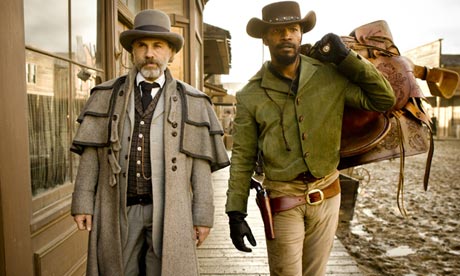
I’ve been wondering why I thought Quentin Tarantino’s Inglorious Basterds (2009) was so smartly wrathful, creative and magnificent and why I was so disappointed with Django Unchained (2012), the second in what one can only hope are a series of willful rewritings of history. With its wonderful acting, costuming and lighting, the film was certainly as much of a pleasure to simply look at as Inglorious Basterds was.

It wasn’t the ultra-violence that bothered me so much. In Django Unchained, the blood splooges out of Tarantino’s characters more comically than ever. Its function goes demonstrably beyond the representational.

It wasn’t the perverse gloss on slavery, which seemed to be a degradingly apt commemoration of a far more perverse economic system. (The terribly hard-to-take mandingo fighting scene also seemed to me to be a degradingly apt portrait of contemporary prizefighting).

It wasn’t the sexism–while a distinct sign of directorial laziness, it was unsurprising and tired enough to be pretty innocuous.

I suppose it was all of these things put together, but above all: Django Unchained doesn’t take the time to reflect upon itself as Inglorious Basterds did. If the leitmotif of Tarantino’s films is exquisite vengeance, his most interesting films have a key moment that calls revenge’s rewards into question. In Inglorious Basterds, this moment takes place inside and outside of the narrative at the same time: Shosanna burns the Nazis alive in a cinema, using nitrate film as fuel. Her malevolence seems to extend to the film we’re engaged in viewing, as well, asking us what any symbolic entertainment featuring good guys and bad guys can ultimately mean.

Perhaps self-reflexivity is Tarantino’s ersatz moral code. It provokes an interesting kind of doubt that gives the revenge added significance, and I couldn’t find that doubt in Django Unchained.

I choose my vehicle and I can cross all bridges

Happy 2013!

An apt beginning to the beginning of the new year: the first few minutes of Kidlat Tahimik’s Perfumed Nightmare (1977).

This sequence is an earnest but wry account of the great determination needed and the great labor involved in taking leave of colonialist oppression, cultural constraints, parochial censure, social prejudices and stigmas, and not least of all, the isolating security of the familiar. Meanwhile, Tahimik notes, established powers and their followers parade across the thoroughfare. The bridge is mediation, says Fredric Jameson in The Geopolitical Aesthetic (1992). The bridge is our bridge of life, says Tahimik.

May we make all crossings–metaphorical and real, difficult and effortless–with Tahimik’s brashness, tempered in equal measure with humor and critical skepticism. We choose our vehicles and we can cross this, any, all bridges!

Ta punition, c’est d’être toi

“I go on as I began: for the beauty of the gesture,” says Denis Lavant’s character midway through the fantastic and fantastically sad Holy Motors. As he (Monsieur Oscar) utters those words, peeling the prosthetic skin off of his face and glaring strangely at Michel Piccoli’s character, I could feel the sparse and scattered audience around me in the movie theater stiffen slightly, as if a low voltage current had gone through all of us. This is what this film means, we all thought to ourselves, thrilling to the justification and the way it matched the wondrous and gross and disconcerting gestures we had been watching for the last hour.

A fine understanding of how astonishingly beautiful la geste can be unites all of Leos Carax’s films. In them, this gesture is a passionate and extreme employment of the body that encompasses and surpasses both use-value and exchange-value. These gestures are the panache from Cyrano de Bergerac. They are the synaesthetic moments in Rimbaud. They are the senses put to art, no matter whether the bodies that house these senses and the situations that result are hideous or obscene, funny or touching or elegant. Carax engineers these gestures on screen, but he hopes that as spectators, we will complete them.

It has been well documented by now that Holy Motors pays tender tribute to film history, from Carax’s own filmmaking to George Franju’s love of l’insolite to Étienne-Jules Marey‘s serial photography (with many in between). Perhaps film isn’t the only art form that can produce the gesture of which Monsieur Oscar speaks, but it might well be the only one that can capture the quest as well as the fleeting result.

“The [story of cinema] starts with the human body, or an action,” Carax tells Interview magazine.

“We always have, and we still love to watch human bodies in action. We also love to watch landscapes or things we have created, buildings or cigarettes, guns and cars… but above all, we love to watch human bodies, whether they’re walking, running, fucking, or anything.”

The plight explored in Holy Motors is twofold. First: how can art as a sensual gesture be created and recreated in a world which increasingly de-emphasizes the embodied use of the senses? Second: how can art be created and recreated by artists as their bodies and senses change, fatigue and deaden with the passage of time?

Carax suggests a multiplicity of answers to these questions as he takes us around his Paris. (Will this be the last film which manages to make Paris penultimately modern and eternal at the same time?) Viewers can choose to hold onto the ecstatic parts of Holy Motors (like the entr’acte above) or the maudlin ones. Or even accept la grande geste in all its complexity.

Like the young daughter Monsieur Oscar drops home in a fury after picking her up from a house party, Carax is brutal with us: our punishment is being ourselves, and having to live with that. Yet he clearly shows us the flip-side of this punishment, as well: our lives of the senses.