I’ve been cleaning out my bookmarks, and re-found this lovely piece by Jonas Mekas from 1996. It’s reprinted here at Incite: Journal of Experimental Media, From Mekas’s website, the original draft:


I’ve been cleaning out my bookmarks, and re-found this lovely piece by Jonas Mekas from 1996. It’s reprinted here at Incite: Journal of Experimental Media, From Mekas’s website, the original draft:

HER, Spike Jonze, 2013. Image accessed at http://c.fastcompany.net/multisite_files/fastcompany/imagecache/inline-large/inline/2013/12/3023517-inline-i-3-what-we-can-learn-about-the-future-of-ai-mobile-design-love-and-pants-from-spike-jonzes-her.jpg
Her is the kind of film I didn’t like, but would like to teach. Given the number of excellent critical reviews already out there, I don’t so much want to add to them as to use the film as a node from which to lay out a network of ideas from several visual studies texts.
I. In Carnal Thoughts: Embodiment and Moving Image Culture (2004), Vivian Sobchak writes that “many people describe and understand their minds and bodies in terms of computer systems and programs (even as they still describe and understand their lives in terms of movies)” (137). I’ve come to think of this split and disconnect metaphorized in different media as Her‘s central drama. Theodore has all these cinematic desires and needs and can’t figure out which circuitry inside himself they connect to; instead of film programming his own mind and body cum computer system he channels all of his efforts at connection and narrativization into a store-bought one.
II. Like the beautiful, handwritten letters Theodore gets paid to squeeze out, Jonze churns up all sorts of affect in Her but only succeeds in moving those spectators who confuse affect with emotion. For the rest of us, as Marie-Luise Angerer has so succinctly put it, this “enthusiasm for the affective, then, conceals an actual fear of affect, the fear of having (and being) nothing more than the need to dissolve oneself (one’s ego).” (“Feeling the Image: Some Critical Notes on Affect,” in Imagery in the 21st Century, Oliver Grau and Thomas Veigl, eds., 219)
III. Re: character names and their tells: Theodore (Roethke?) (Cy) Twombly? The perfect mash-up of sad macho confessionalism and epic unfinishedness. Samantha should have been named Dolores, I think. All of the actresses cast in the film were such purposefully underage-looking nymphs that this name would have given us a matching impression of Theodore’s Tinkerbell/girlfriend.
IV. There were plenty of aspects of the future in Her for which I found I could not suspend my belief: the universal wealth, climate change apparently being a complete non-issue, the nonexistence of anyone outside of the 25-45-year-old demographic. Most intriguing and unbelievable, though, was the centrality of the voice to cutting-edge technology. Leaving the theater and looking around me at all of the humans in silent communion with their devices, I wondered: how would Jonze have us go from an instant message and photo culture where people no longer feel able to leave voicemail to a culture in which early adapters thrill to the grain of the cybervoice?
V. The majority of the dialogue between Theodore and Samantha is replete with the “working on myself” vocabulary of contemporary theraputic culture. In Her, the perfect woman is not virgin nor whore but mental health care professional.
VI. In “Death Every Afternoon,” André Bazin wrote,
Like death, love [i.e., making love] must be experienced and cannot be represented (it is not called the little death for nothing) without violating its nature…I imagine the supreme cinematic perversion would be the projection of an execution backward like those comic newsreels in which the diver jumps up from the water back onto his diving board. (reprinted in Rites of Realism: Essays in Corporeal Cinema, edited by Ivonne Margulies, 2003. 30, 31)
I thought of backwards executions as Jonze made us listen to the sounds of Theodore and Samantha’s virtual sex in the dark. Perhaps fading the screen to black during this was supposed to be a romantic discretion? It only made the sequence more voyeuristic and lonelier, like listening to the couple next door through a motel wall.
VII. Several critics have commented on the retromoding of Theodore’s smartphone. In Artforum, Melissa Anderson compares it to “an index-card-size daguerrytype camera.”
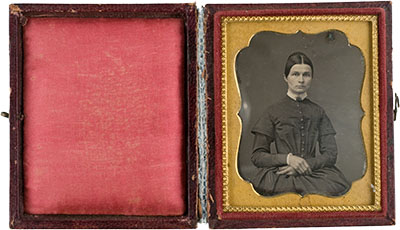
I don’t see the camera similarity, but I, too, thought of daguerreotypes in their protective Union Cases while watching Her. Indeed, the dominant atmospheric color in the film could be called “Daguerreotype crimson” in honor of the soft protective lining in these mid-nineteenth-century cases.

Daguerreotype, circa 1850. Image accessed at http://www.phototree.com/photos/Full_Case_0763.jpg
Impossible not to be reminded here of Walter Benjamin and his writing on the metonymy of plush cases for the nineteenth century:
The nineteenth century, like no other century, was addicted to dwelling. It conceived the residence as a receptacle for the person, and it encased him with all his appurtenances so deeply in the dwelling’s interior that one might be reminded of the inside of a compass case, where the instrument with all its accessories lies embedded in deep, usually violet folds of velvet. What didn’t the nineteenth century invent some sort of casing for! Pocket watches, slippers, egg cups, thermometers, playing cards and, in lieu of cases, there were jackets, carpets, wrappers and covers. (The Arcades Project, 221)
If for Benjamin, the twentieth century had lost its cushy protection, Jonze’s after-the-twenty-first century restores that bourgeois coziness in the form of clothing as well as technological accoutrements.
VIII. Her is not a cautionary tale or a dystopian sci-fi film. It’s not a romance, either–comedy or tragedy. It is a self-defensive diorama of interpersonal failure. Emily Maitlis nailed it with the term “fetish fantasy;” what feels safer than waxing moralistic on the taboo behavior in which one secretly wants to indulge, like falling in love with oneself via an all-knowing avatar?
News Item #1: Google Glass–a smartphone in the form of eyewear–is now available to any wealthy early adapter in the U.S. who doesn’t mind a still substandard product at almost 10 times the price of manufacture.
News Item #2: The European Court of Justice ruled that Google must, upon an EU citizen’s reasonable request, take down links to information about him or her that is “inadequate, irrelevant…or excessive.” Newspapers have dubbed this “the right to be forgotten,” but making that argument unhelpfully anthropomorphizes the search engine. The right here is to obscurity, to a user’s control over his or her selective accessibility via data trail.
In order to truly grasp the legal, ethical, and social problems involved in Google’s bid to become a 21st century holistic lifestyle management interface, we must relate these news items to one another as two smaller skirmishes within a larger battle over virtual agency. We need to posit Google as an extensive operating system more so than just a purveyor of internet services, and it must be not only regulated as one, but subverted as one, as well.
Easier said than done! Earlier this year, I published a review in the journal Parallax of a book that conceptualizes media as “humans-plus-technology” operating systems and encourages us to improve at subverting these operating systems. That book was Matthew Fuller and Andrew Goffey’s Evil Media (MIT Press, 2012).
Here is an excerpt from my review. I start by considering the meaninglessness of Google’s by now long-repressed corporate maxim, “don’t be evil.”
With no verifiable referent, ‘don’t be evil’ is a prime example of proferential language, ‘the language of verbal entities and vague, fuzzy realities’ (p.143). Google’s middle management maintains and propagates that vagueness in language to the company’s market advantage, and this action is one of a panoply of worst practices in media that Matthew Fuller and Andrew Goffey highlight in their new book.
Their text builds on the cognitive science model of the expanded mind, which posits cognition as something far beyond synapses: rather, an entire system of biological and non-biological processes connecting brains, people, things and information. For Fuller and Goffey, the phenomenon of mass mediation must likewise be understood as more than just the hardware and software of communications technologies. Media connote an ecology of things, technologies, social debates and theory, an argument that Fuller has made more comprehensively in his excellent Media Ecologies.
In Evil Media, the focus is not on ecologies of news media or social media but rather the ‘grey media’ (p.12) that form
crucial but overlooked ‘sociotechnical habitats’ (p.13) in the recesses of these and other networks. Systems administration, data mining and project-planning software are prime examples of grey media. The proferential language middle managers use in meetings, written directives and public policies is continuous with grey media that distribute these convoluted messages.
When grey media devices, methods and techniques are instrumentalized as stratagems, Fuller and Goffey propose we term them ‘evil media’. Evil media are a set of ‘troubling, ambiguous social processes, fragile networks of susceptible activity, [and] opaque zones of nonknowledge’ (p.3). The book aspires to be a ‘compendium of evil media stratagems’ (p.140), a baleful manual detailing the non-transparent, anxiety-inducing, paranoia-sustaining, team-controlling, error-encouraging, work-abstracting, privacy-destroying, nasty, harmful and/or illegal moves that media and its human extensions accomplish together.
This approach represents a compelling alternative to the study of media from the spectatorial point of view. It replaces that perspective with a vue d’ensemble of media’s content, function and context (p.2), emphasizing the activation and deactivation of media assemblages instead of the acts of looking that take place inside of them. Most importantly, this compendium is also a user’s guide: Fuller and Goffey want readers to learn the value of the stratagematic use of media from their best enemies.
Inspired by Google’s ‘don’t be evil’, Fuller and Goffey perform an ingenious three-way declension in their text. They criticize the priggishness of this imperative, reveal its hypocrisy and turn its empty platitude inside out. Doing so is fighting fire with fire, contesting a transformation of the social into a dataset, and the transformation of that dataset into ‘an agency that no longer merely molds citizens but rather spins not their words but their activities continuously by changing the shape of the environment in which they act, innocuously, felicitously, abruptly’ (p.95). Mould, spin, subvert, sabotage, deviate – be evil in turn, the book exhorts.
As a coda to this post: earlier this spring, CEO of German publishing company Axel Springer wrote a public letter to Google CEO Eric Schmidt about his company’s predicament as client of Google’s and a participant in the European antitrust case against Google. “Google doesn’t need us. But we need Google…We are afraid of Google,” he bluntly stated. Coming as it did after the antitrust investigation settled with Google (largely in Google’s favor), Mathias Döpfner’s letter is more of a pious ruefulness than a call to arms. However, it did offer one insight that marks the spot to start hitting at Google’s worst practices from below:
Google is the world’s most powerful bank – but dealing only in behavioral currency. Nobody capitalizes on their knowledge about us as effectively as Google.
How, then, without antitrust legislation against Google and other such multinationals, can capitalize on our self-knowledge in such a way that our behaviors aren’t media’s currency?
A couple of weeks ago, I learned through friends on social media that Happy, Pharrell’s latest earworm, had become a sort of current day revolutionary anthem. I reacted with surprise and skepticism. Where, in a song called “Happy,” could the catalyzing negativity so necessary for direct action be found?
I took a closer listen. “This song isn’t about happiness at all,” I thought. “It’s about imperviousness. It’s about self-empowerment, about transcendence. Boundlessness. Agency.” Perhaps these emotions can be found embedded within individual life and romantic love, but they are also crucial ingredients for collective resistance. Suddenly it made more sense that Brazilian students might want to claim the song as their own as they protest the mismanagement and misuse of national funding for World Cup preparation whilst so many of their fellow citizens live in appallingly poor conditions.
The sheer inner resolve that this pop song celebrates can be directly matched to the “joyful wisdom” that Friedrich Nietzsche wrote about:
“Joyful Wisdom” : that implies the Saturnalia of a spirit which has patiently withstood a long, frightful pressure patiently, strenuously, impassionately, without submitting, but without hope—and which is now suddenly o’erpowered with hope, the hope of health, the intoxication of convalescence.
The proof? Below. Slavoj Žižek eat your heart out!
Happy
(Pharrell Williams, 2013)
It might seem crazy what I’m about to say
Sunshine she’s here, you can take a break
I’m a hot air balloon that could go to space
With the air, like I don’t care baby by the way[Chorus:]
Because I’m happy
Clap along if you feel like a room without a roof
Because I’m happy
Clap along if you feel like happiness is the truth
Because I’m happy
Clap along if you know what happiness is to you
Because I’m happy
Clap along if you feel like that’s what you wanna do
Here come bad news talking this and that, yeah,
Well, give me all you got, and don’t hold it back, yeah,
Well, I should probably warn you I’ll be just fine, yeah,
No offense to you, don’t waste your time
Here’s why
[Chorus]Bring me down
Can’t nothing bring me down
My level’s too high
Bring me down
Can’t nothing bring me down
I said (let me tell you now)
Bring me down
Can’t nothing bring me down
My level’s too high
Bring me down
Can’t nothing bring me down
I said[Chorus 2x]
Bring me down… can’t nothing…
Bring me down… my level’s too high…
Bring me down… can’t nothing…
Bring me down, I said (let me tell you now)
Certainly this man, notwithstanding his youth, understands the improvisation of life, and astonishes even the acutest observers. For it seems that he never makes a mistake, although he constantly plays the most hazardous games. One is reminded of the improvising masters of the musical art, to whom even the listeners would fain ascribe a divine infallibility of the hand, notwithstanding that they now and then make a mistake, as every mortal is liable to do. But they are skilled and inventive, and always ready in a moment to arrange into the structure of the score the most accidental tone (where the jerk of a finger or a humour brings it about), and to animate the accident with a fine meaning and soul.
Here is quite a different man ; everything that he intends and plans fails with him in the long run. That on which he has now and again set his heart has already brought him several times to the abyss, and to the very verge of ruin ; and if he has as yet got out of the scrape, it certainly has not been merely with a “black eye.” Do you think he is unhappy over it? He resolved long ago not to regard his own wishes and plans as of so much importance. “If this does not succeed with me,” he says to himself, ” perhaps that will succeed ; and on the whole I do not know but that I am under more obligation to thank my failures than any of my successes. Am I made to be headstrong, and to wear the bull’s horns? That which constitutes the worth and the sum of life for me, lies somewhere else ; I know more of life, because I have been so often on the point of losing it ; and just on that account I have more of life than any of you!” (The Joyful Wisdom, Part IV, Sanctus Januarius, Thesis 303.)
…
No ! Life has not deceived me ! On the contrary, from year to year I find it richer, more desirable and more mysterious—from the day on which the great liberator broke my fetters, the thought that life may be an experiment of the thinker—and not a duty, not a fatality, not a deceit !—And knowledge itself may be for others something different ; for example, a bed of ease, or the path to a bed of ease, or an entertainment, or a course of idling,—for me it is a world of dangers and victories, in which even the heroic sentiments have their arena and dancing-floor.
“Life as a means to knowledge”—with this principle in one’s heart, one can not only be brave, but can even live joyfully and laugh joyfully ! And who could know how to laugh well and live well, who did not first understand the full significance of war and victory ? (The Joyful Wisdom, Part IV, Sanctus Januarius, Thesis 324.)
…
Dance, oh ! dance on all the edges.
Wave-crests, cliffs and mountain ledges,
Ever finding dances new!
Let our knowledge be our gladness,
Let our art be sport and madness.
All that’s joyful shall be true! (The Joyful Wisdom, Appendix, “A Dancing Song to the Mistral Wind.”)

Dwarf “ghost galaxies” Leo IV, Ursa Major and Hercules as seen by the Hubble Space Telescope, 2012.
Two selections from Giorgio Agamben’s “What Is the Contemporary?” published in Nudities, translated by David Kishik and Stefan Pedatella (Stanford: Stanford University Press, 2011), pages 13-15.
3. The poet–the contemporary–must firmly hold his gaze on his own time. But what does he who sees his time actually see? What is this demented grin on the face of his century? I would like at this point to propose a second definition of contemporariness. The contemporary is he who firmly holds his gaze on his own time so as to perceive not its light but rather its darkness. All eras, for those who experience contemporariness, are obscure. The contemporary is precisely the person who knows how to see this obscurity, who is able to write by dipping his pen in the obscurity of the present. But what does it mean “to see an obscurity,” “to perceive the darkness”?
The neurophysiology of vision suggests an initial answer. What happens when we find ourselves in a place deprived of light or when we close our eyes? What is the darkness that we see then? Neurophysiologists tell us that the absence of light activates a series of peripheral cells in the retina called “off-cells.” When activated, these cells produce the particular kind of vision that we call darkness. Darkness is not, therefore, a privative notion (the simple absence of light, or something like nonvision) but rather the result of the activity of the “off-cells,” a product of our own retina. This means, if we now return to our thesis on the darkness of contemporariness, that to perceive this darkness is not a form of inertia or of passivity. Rather, it implies an activity and a singular ability. In our case this ability amounts to a neutralization of the lights that come from the epoch in order to discover its obscurity, its special darkness, which is not, however, separable from those lights.
The ones who can call themselves contemporary are only those who do not allow themselves to be blinded by the lights of the century and so manage to get a glimpse of the shadows in those lights, of their intimate obscurity. Having said this much, we have nevertheless still not addressed our question. Why should we be at all interested in perceiving the obscurity that emanates from the epoch? Is darkness not precisely an anonymous experience that is by definition impenetrable, something that is not directed at us and thus cannot concern us? On the contrary, the contemporary is the person who perceives the darkness of his time as something that concerns him, as something that never ceases to engage him. Darkness is something that–more than any light–turns directly and singularly toward him. The contemporary is the one whose eyes are struck by the beam of darkness that comes from his own time.
In the firmament that we observe at night, the stars shine brightly, surrounded by a think darkness. Since the number of galaxies and luminous bodies in the universe is almost infinite, the darkness that we see in the sky is something that, according to scientists, demands an explanation. It is precisely the explanation that contemporary astrophysics gives for this darkness that I would now like to discuss. In an expanding universe the most remote galaxies move away from us at a speed so great that their light is never able to reach us. What we perceive as the darkness of the heavens is this light that, though traveling toward us, cannot reach us, since the galaxies from which the light originates move away from us at a velocity greater than the speed of light.
To perceive, in the darkness of the present, this light that strives to reach us but cannot–this is what it means to be contemporary. As such, contemporaries are rare. And for this reason, to be contemporary is, first and foremost, a question of courage, because it means being able not only to firmly fix one’s gaze on the darkness of the epoch but also to perceive in this darkness a light that, while directed toward us, infinitely distances itself from us. In other words it is like being on time for an appointment that one cannot but miss.
4. This is the reason why the present that contemporariness perceives has broken vertebrae. Our time, the present, is in fact not only the most distant: it cannot in any way reach us. Its backbone is broken and we find ourselves in the exact point of this fracture. This is why we are, despite everything, contemporaries. It is important to realize that the appointment that is in question in contemporariness does not simply take place in chronological time: it is something that, working within chronological time, urges, presses, and transforms it. And this urgency is the untimeliness, the anachronism that permits us to grasp our time in the form of a “too soon” that is also a “too late”–of an “already” that is also a “not yet.” Moreover, it allows us to recognize in the obscurity of the present the light that, without ever being able to reach us, is perpetually voyaging toward us.
I stumbled upon this documentary about Jean Cocteau (dir. Edgardo Cozarinsky, 1985) several months ago, and saved it to my bookmarks. Last weekend I re-discovered the link, and spent part of Tuesday’s April Central New York snow flurries watching it.
Nothing special, but I took pleasure in Cocteau’s repeated insistence on two contradictory artistic impulses: his ambition to know himself and become known, and his desire to keep himself hidden and obscure to himself and all others, as an unmappable and untappable source of creativity.
Some of Cocteau’s bon mots from the film:
We are the workers of a darkness that belongs to us, but eludes us. This profound man–we don’t know him well at all–is our true self. He is hidden in the shadows. He commands us. I decided to plunge down into myself, into this formidable hole, into this unknown mine, at the risk of running into explosive gas.
Honors–one must envision them as a sort of transcendent punishment.
We are the very humble servants of a force that lives in us. We are led–we are led by a force that isn’t external to us–it’s internal. We are led by this night that is our true self.
To celebrate the coming of spring, an Egon Schiele watercolor and some images of his poetry (a.k.a. thought-into-word art).These are all from the Leopold Museum’s 2008 catalogue, Der Lyriker Egon Schiele: Briefe und Gedichte 1910-12. As the museum explains,
Many of Egon Schiele’s letters and poems are designed almost as graphic artworks. The themes are similar to those in his images: personal visions of massive expressive power, full of vividness and immediacy. Unusual word combinations and word creations, grammatically incomplete sentences and the graphic translation of thought dashes mark this unusual atmospheric speech.
A modest offering during this hectic period, but a visually enjoyable one, even for non-Germanophones.

Egon Schiele, Recollection of the Green Stockings, drawing and watercolor

Egon Schiele, A Self-Portrait, poem

Egon Schiele, A Self-Portrait, poem
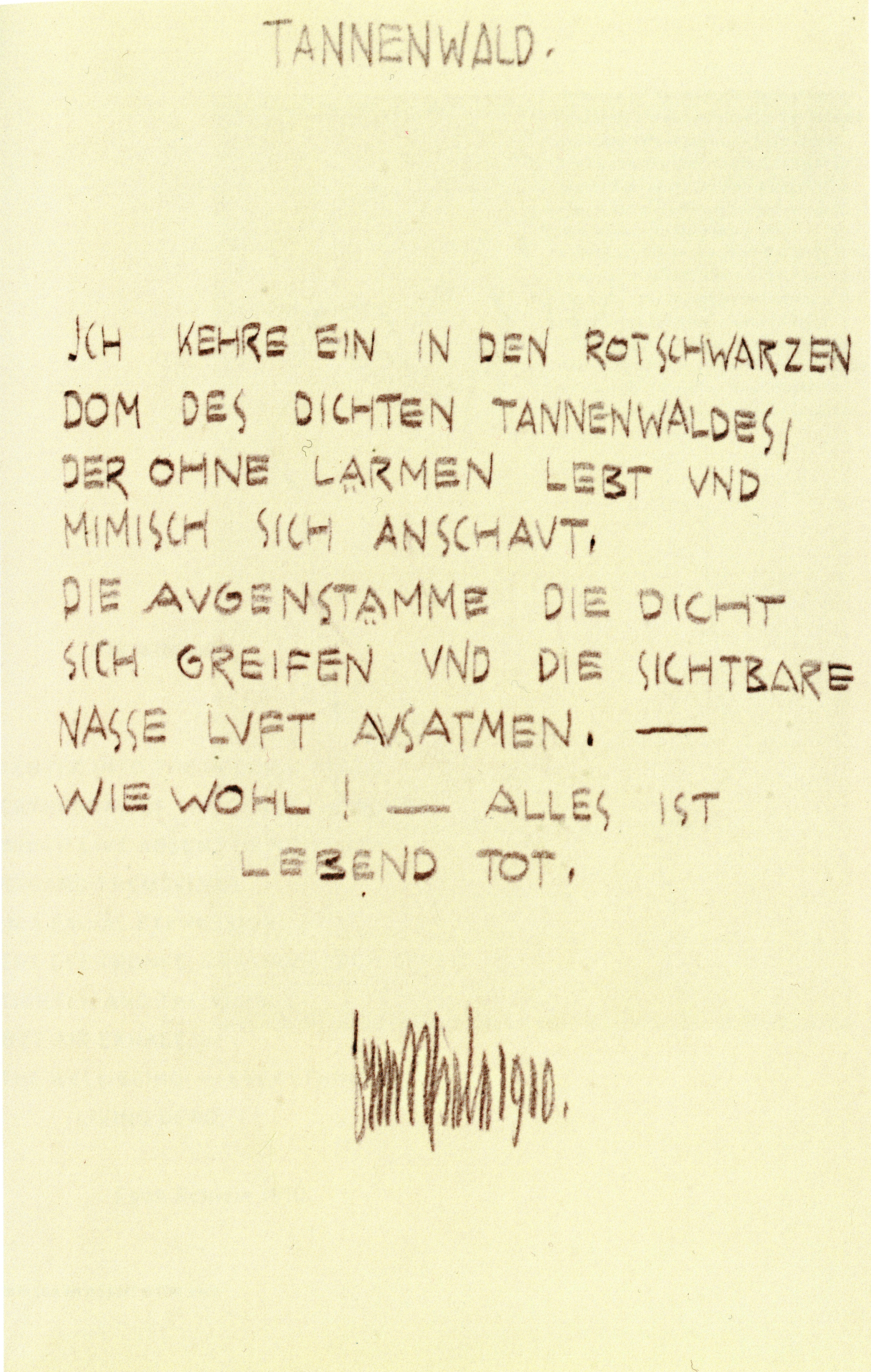
Egon Schiele, Fir Forest, poem
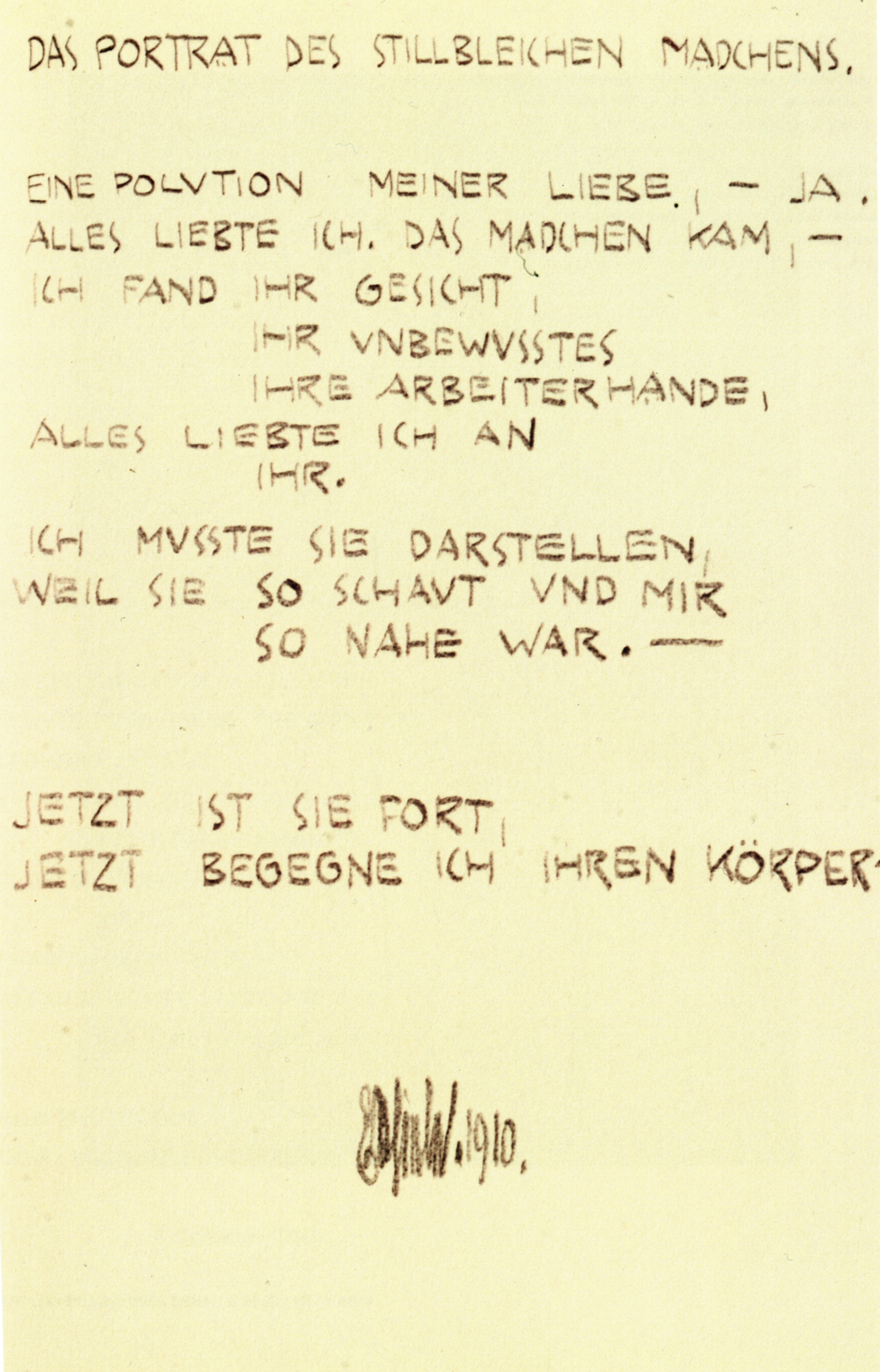
Egon Schiele, The Portrait, poem

Egon Schiele, Country Road, poem
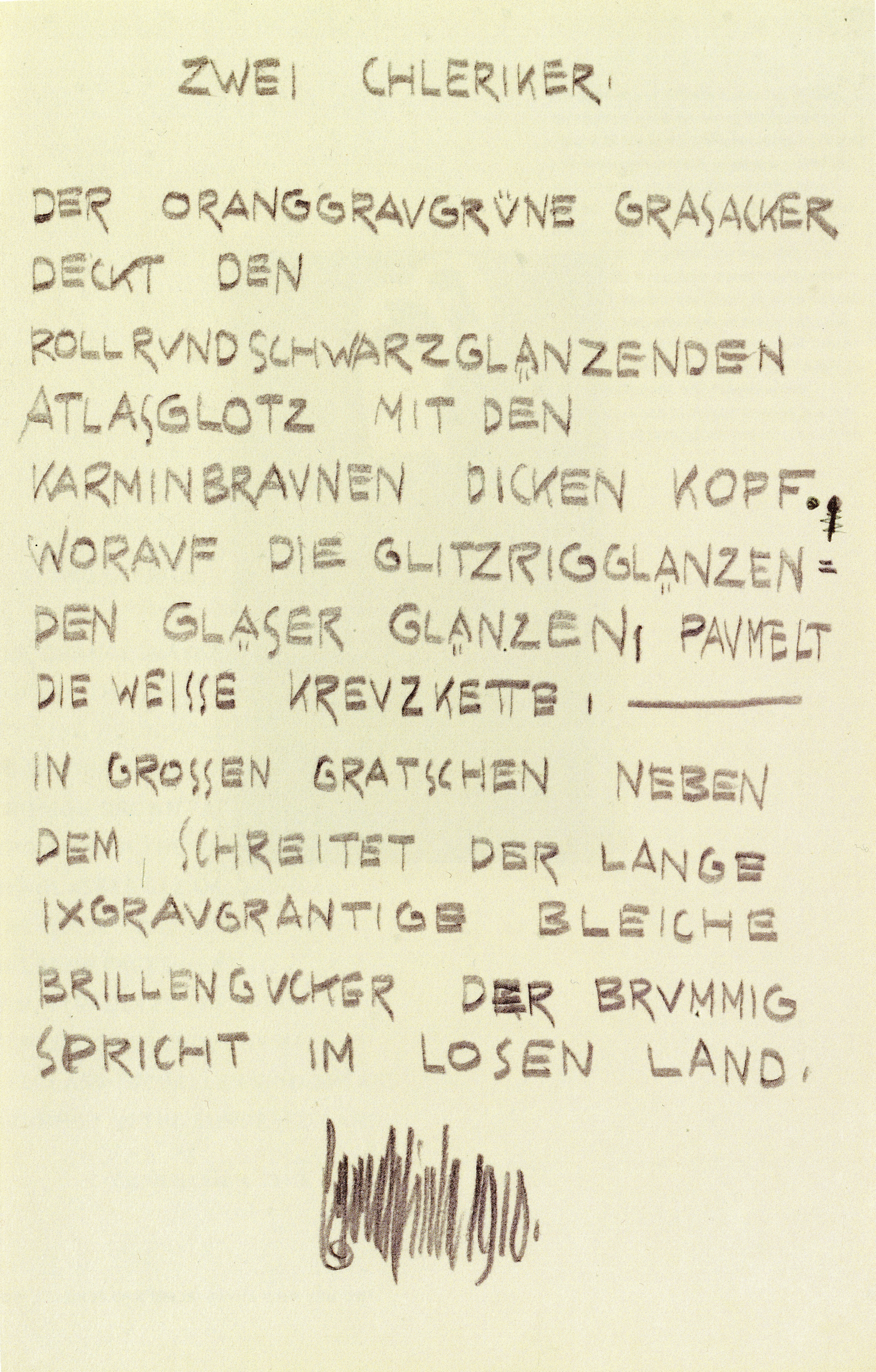
Egon Schiele, Two Clergymen, poem
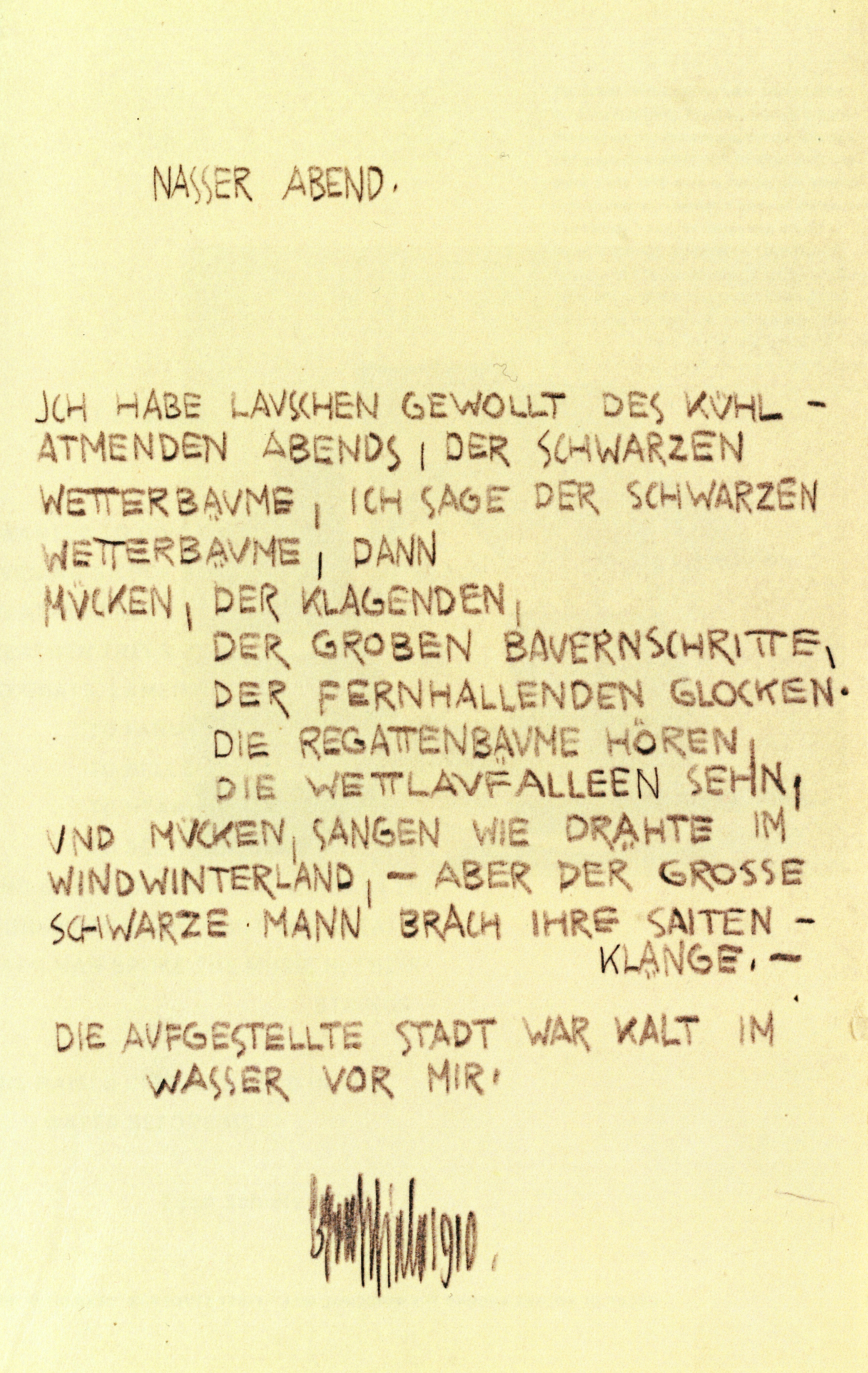
Egon Schiele, Wet Evening, poem
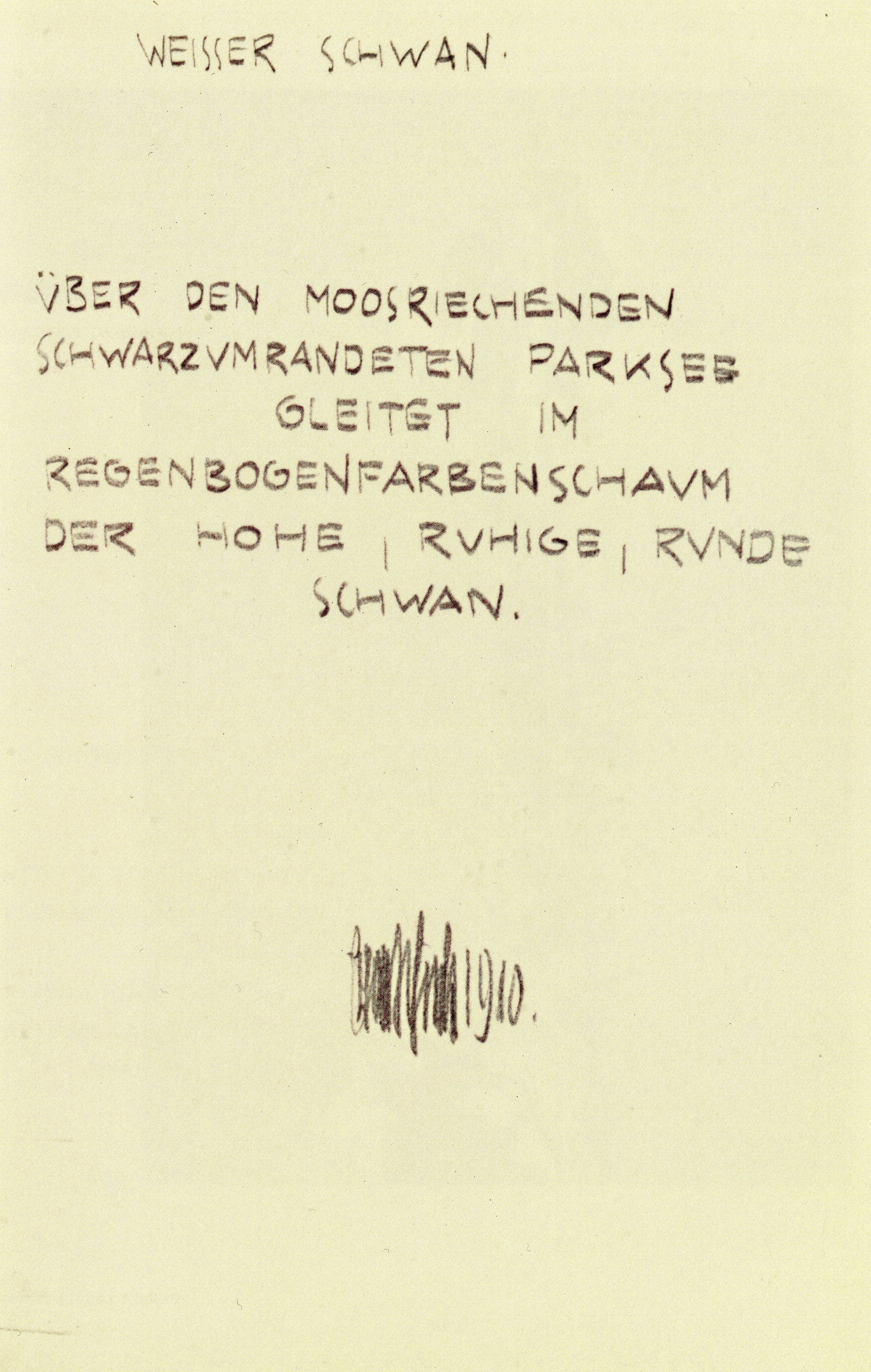
Egon Schiele, White Swan, poem
UPDATE 8/20/15: More Schiele for the viewing at Artsy.net’s Egon Schiele page.
I’m pleased to announce the publication of my article, “The Paradigms of Nicolas Bourriaud: Situationists as Vanishing Point” in the current issue of Evental Aesthetics.

It was great to work with the journal’s editorial board–their thoughtful commentary was some of the most dedicated peer-review that I’ve yet encountered.
My article was inspired in part by a show curated by Nicolas Bourriaud at the Palais des Beaux-Arts that I’ve written about here. I grew fascinated by the ever-morphing aesthetic paradigms that Bourriaud has created for his publications and his exhibitions over the past several decades in order to characterize contemporary art.
My article follows the trajectory of Bourriaud’s paradigm production, suggesting that much of it is based on a process of updating and back-dating some of the key concepts that the Situationist International set forward in their eponymous collective journal. I propose that Bourriaud’s formalism-as-theory is far better understood as descriptive of his own creative project than as a framework for contemporary artistic practices.
The abstract of my piece is here, and the PDF here.
An excerpt from the article:
What Bourriaud presents in Relational Aesthetics is considered one of the defining aesthetic debates of the late twentieth and early twenty-first centuries. In Artificial Hells: Participatory Art and the Politics of Spectatorship, Bishop writes that Bourriaud’s book helped “render discursive and dialogic projects more amenable to museums and galleries,” and indeed, Bourriaud launched the careers of many artists who have since been the subjects of museum retrospectives and scholarly publications.[5] Taught in contemporary art seminars worldwide, often juxtaposed with its rejoinders, Relational Aesthetics has contributed to the institutionalization of participatory art in the form of MFA programs and artists’ prizes, and provoked “a more critically informed discussion” of the practice.[6]
Given such canonization of relational aesthetics and relational art, this article argues that it is crucial to examine the origins, composition and implications of these concepts. Relational aesthetics must be contextualized alongside the paradigms, neologisms and vocabularies that Bourriaud has subsequently developed for the discourse surrounding contemporary artistic creation. Readers and viewers of Bourriaud’s work should understand that regardless of the artists he situates in these evolving, interrelated, conceptual frameworks, he is his own best and most prototypical aesthetic “service provider.” He views his paradigms as creative interventions – “theoretical tools” and “kick starts” for art makers, viewers and philosophers.[7] If what Bourriaud calls his “theory of form” is now serving in an art historical context, it is essential to situate his publications in a historical discursive tradition, and to understand the tradition in which Bourriaud would situate himself.[8]
Full article as PDF here, and as HTML here.
This is the second in a series of reflections that evolve from the undergraduate capstone seminar “Sight and Site in Film and Media” that I am teaching this semester.
Home (2009) is a film that didn’t get anywhere near the attention and critical acclaim it deserved when it was in theaters several years ago. It is a film that ingeniously explores an environment as allegory. My students and I were in awe (admittedly, sometimes agonized awe) of the radical associative openness that director Ursula Meier constructs and sustains for the entire hour and a half of her fictional story.
Set nowhere in particular in France (but actually filmed in Bulgaria), Home takes place within a family that dwells at the edge of an abandoned highway. Abruptly, the highway is reopened. The reasons for its reopening remain as mysterious as its closure– and the family’s move to the house beside it ten years earlier, for that matter.
Is the highway a metaphor for the “information highway” of images and data that saturates 21st century life? Is it rather a psychoanalytical symptom of the traumatic passage to adulthood, the transformations that this nuclear family is on the verge of experiencing in their interrelationships? Can we interpret it as the repressed past of the family’s mother (Isabelle Huppert), surging back to threaten the present? Is the highway just a highway, a wound cut through the paradisiacal landscape surrounding the family?
Home nurtures all of these associations, and more. It is a fascinating, funny and discomforting mediation on the seductive Gezelligheid but also the sure stagnation encompassed in the notion of home, hearth and belonging.
To catalyze our discussion of the film, our seminar read three diverse texts.
We began with selections from Gaston Bachelard’s classic, The Poetics of Space. We weighed Bachelard’s thesis that we create in our lived spaces physical extensions of our various psychologies.
We then contrasted spatial poetics to the spatial dystopia inherent in Marc Augé’s Non-Places: Introduction to an Anthropology of Supermodernity (1992). We had a great debate on the continuing merits of Augé’s paradigm in a quotidian so throughly pockmarked with experiences of non-place.
In every seminar session, I include a reading that represents a clear counterpoint to the meanings evoked in the film we have studied. This represents a challenge to students to argue dialectically between two diverse narratives of place and the practices of looking that they do or do not solicit.
In contrast to Home, we discussed the phenomenon of smart homes. Smart homes represent a domestic application of technological advances in entertainment, building automation, controlled sensory environments and data analytics. We read Lynn Spigel’s “Designing the Smart House: Posthuman Domesticity and Conspicuous Production,” which wisely examines the gender implications of technological homes as threat and promise. We discussed Google’s corporate interests in diversifying their stronghold over informational products to include smart home technologies, and what the implications of that prospective market lockdown might be.
Our session ended with Home‘s ambivalent ending, scored sublimely to Nina Simone’s cover of Wild is the Wind (Dimitri Tiomkin/Ned Washington, 1957). I’ll leave you with that wonderful song and the encouragement to view this film sometime soon.
What a pleasure to receive this publication in my mailbox this week.

It was also a pleasure to contribute a number of short-form essays to it.
I wrote:
an overview of Belgian Surrealist cinema,
and of the short film analyses the book contains, I wrote on Chantal Akerman’s Tout une nuit (1982) and on her magnificent directional tetralogy of the 1990s and 2000s: D’Est (1993), Sud (1999), De L’Autre Côté (2002) and Là-bas (2006).
To celebrate, my text on Là-bas (2006), reproduced here below, and an excerpt of the film in accompaniment.
LA-BAS
Director: Chantal Akerman
Producer(s): AMIP, Paradise Films, Chemah I.S., Le Fresnoy
Cinematographer: Chantal Akerman, Robert Fenz
Sound: Thierry de Halleux
Editor: Claire Atherton
Assistant Editor : Fabio Balducci
Duration: 78 minutes
Year: 2006
Là-bas concludes Akerman’s series of films made between 1993 and 2006, based on the themes of place and displacement, physical and emotional space. While D’Est (1993), Sud (1999), De L’Autre Côté (2003) and Là-bas (2006) are frequently grouped as a foursome of essay films, a pairing of two and two seems more apt. D’Est and Sud examine a socio-historical event of the recent past, showing the wake it has left in the lives of local inhabitants. In them, a major transition has taken place, and the films’ subjects must find a way to remember and rebuild. De L’Autre Côté and Là-bas are about the presence of containment and isolation in the everyday; the subjects in these films must themselves become transitory in order to cope with chronic problems or unmoving obstacles.
Là-bas takes place in Tel Aviv, Israel, but the film is never directly about Israel or its culture. Nor is it directly about Akerman, herself; viewers catch only a fleeting glimpse of her, and her rough and sensuous smoker’s voice is only heard intermittently in voiceover. In one of these voiceovers, Akerman gives a wry description of her project: “I stay here in the apartment, and I eat what my landlord has left, and I read very complicated books about the Jews. I take notes, I reread them, I try to understand. Sometimes I understand. Or I get a whiff of something, something that is already there inside of me, but I can’t express.” At the beginning of the film, she juxtaposes the suicide of her aunt and of the mother of Israeli author Amos Oz, the former in Brussels and the latter in Tel Aviv. “Was it for both of them a sort of exile, wherever they were?” she asks. These diaristic soliloquies and the partitioned images which accompany them evoke the difficult negotiation of exile and return that Akerman and others touched by the Jewish diaspora must undertake.
Là-bas is comprised almost entirely of static long shots. Most of these are of the high-rise apartment buildings directly opposite Akerman’s own vacation apartment, seen through the rattan window blinds. Twice, we see footage shot outdoors at the seashore. The first sequence is a welcome release from the confines of the apartment, but by the second sequence, this watery expanse overwhelms the senses, triggering a desire to return to the familiar, dark living room. In the last four minutes of film, the camera pans and zooms rapidly across the open sky. The montage provokes anxiety and a dizzying feeling of disorientation, the same emotional states Akerman has been describing, perhaps suggesting an ontological state of Israel itself.
At first, it seems Akerman is spying on her neighborhood. The subject matter, the fixity of the camera, the medium of digital video and its generic deep focus immediately calls to mind surveillance footage. The film’s ambient noise, however, complicates this interpretation. Sounds of street traffic and hollering children mingle liberally with sounds coming from the unseen interior of the apartment, like the click of a gas burner on the stovetop, footfalls, objects moved around on a counter or table, or the tapping of computer keys. There is a profound ambivalence between what can and cannot be seen. The gaze of Akerman’s camera is not all-seeing and impassive, but rather unseeingly subjective in nature. This, too, she supposes, is linked to Belgium and her past, as she spent much of her childhood gazing out the window at children she was not allowed to go play with. “Now I’m in the habit of looking out the window,” she says. “I look and I get all up inside myself.”
If, amidst these dark meditations on personal and national prisons, Là-bas also affirms life, this affirmation is found in Akerman’s devotion to creative work, in many senses a direct result of and an antidote to her non-belonging. The man with a balcony and a rooftop garden directly opposite Akerman’s window embodies this devotion, suggesting that Akerman’s work as a Belgian Jew reconciling herself to Israel is in many senses collective work. The man tends restlessly to his potted plants, watering, inspecting and repositioning them as a contemporary Candide would, cultivating his garden. Akerman does the same, learning through her filmmaking to “put down roots in space.”
 Jennifer Stob